Free Narrow CPR Stock Scanner: Daily Shortlist for Breakout Trades
Narrow CPR · Stock Scanner
There are no items in your cart
Add More
Add More
| Item Details | Price | ||
|---|---|---|---|
A step-by-step guide to the Weekly CPR below Daily CPR for Bullish setup — a high-probability intraday uptrend strategy for Nifty 50, Bank Nifty, and high-volume stocks, and why it tends to push call option premiums higher.
If you've been searching for the best strategy for intraday trading, there's a good chance you've come across CPR (Central Pivot Range) indicator — and for good reason. Among the dozens of CPR-based setups traders use, one of the most reliable is the Weekly CPR below Daily CPR alignment, combined with price trading above both. When this setup forms on high-volume stocks, Nifty 50, or Bank Nifty, it often signals the start of a strong intraday uptrend — and for Future and options traders, that uptrend directly translates into rising call option premiums and future Price.
This exact setup is one of the core building blocks taught inside the CPR Brahmastra Strategy — Live Webinar on Stock Market Trading, where it's broken down live Sessom on real commodity and Index charts every Sunday at 8 pm. In this blog, we'll walk through exactly what the setup ABC is, why it works in Intraday and Swing Trading, and how to trade it with proper risk management.
💡 Quick take: Weekly CPR below Daily CPR + price sustaining above both + strength confirmation = one of the cleanest multi-timeframe bullish alignments in intraday trading. Save this framework — you'll want to check it before every trading session.
CPR is a price-based support and resistance framework built from three levels calculated using the previous session's high, low, and close:
Together, TC, Pivot, and BC form a "range" that acts like a magnet for price. A Narrow CPR often signals an upcoming breakout, while a Wide CPR usually reflects a strong prior trend already in motion. Above Formula I have taken it from Book Profitable Trading Strategies with Psychology by Anil Hanegave.
CPR can be plotted on multiple timeframes — but for this strategy, I am consideting two: Daily CPR (calculated from the previous day's data) and Weekly CPR (calculated from the previous week's data).
Most day traders and scalpers only watch Daily CPR. But Daily CPR alone only tells you about short-term intraday bias. Weekly CPR adds the bigger-picture, multi-day context.
| Calculated From | Reflects | |
| Daily CPR | Previous day's H/L/C | Short-term, intraday bias |
| Weekly CPR | Previous week's H/L/C | Medium-term, positional bias |
When you use both on your chart, available free Download here their relative position to each other tells you far more than either does alone.
Here's the core strategy:
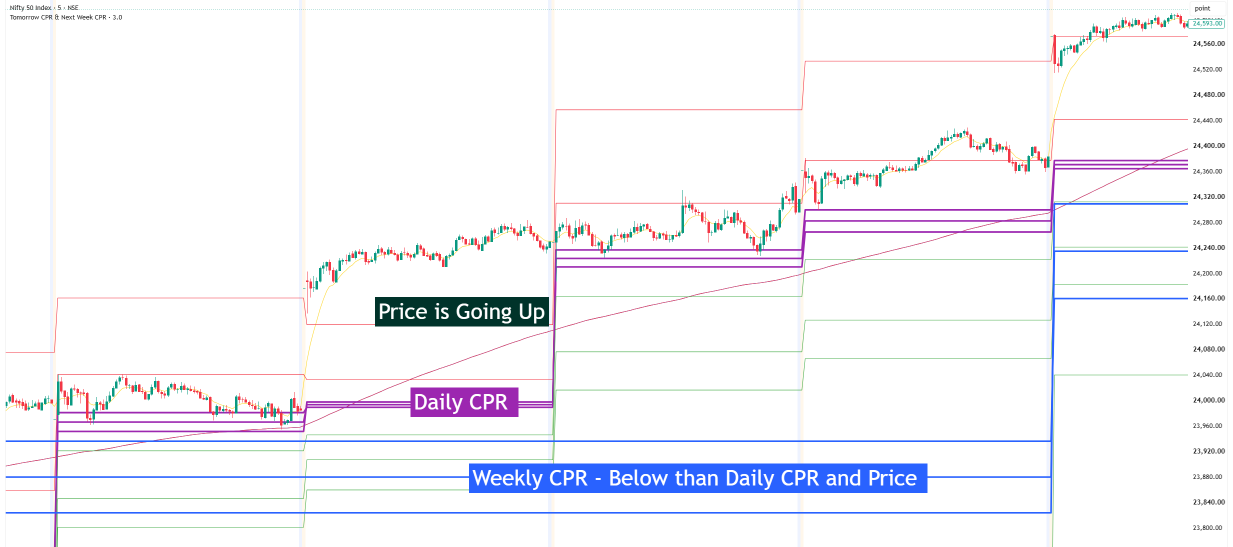
"When the Weekly CPR sits below the Daily CPR, and price is trading above both ranges, see attached Nifty 50 chart, it signals that both the medium-term and short-term structures are aligned bullish."
Why this matters:
I use 5 min timeframe for Day trading, and 15 min timeframe for Options selling. This is what typically forms and sustains an uptrend: price keeps making higher lows above the Daily CPR, using it as dynamic support, while the Weekly CPR sitting further below acts as a secondary cushion, keeping the broader structure bullish.
For options traders, this setup matters even more because of how option pricing works:
This is exactly why this CPR alignment is popular among option buyers — it isn't just a "price will go up" signal, it's a signal for where premium expansion is most likely to be sharp and sustained, rather than a slow grind.
This setup works best on instruments with strong liquidity and clean price discovery:
Avoid applying this strategy on low volume manipulated traded stocks — CPR (like any technical framework) depends on genuine participation to hold up.
★★★★★ "I went from random intraday losses to following a rule-based CPR approach in under two months. The indicator completely changed how I read charts."
— Vikram D., Intraday Trader, Nagpur
CPR works best as a framework, not a standalone signal. Pairing it with price action, Smart Money Concepts (SMC), and Open Interest data (via tools like Sensibull for options chain analysis) helps filter out false breakouts and confirms that the move has real participation behind it — not just noise around a level.
This Weekly-CPR-below-Daily-CPR framework is just one piece of a bigger system. The CPR Brahmastra Strategy program builds on it with:
🔥 Seats for each Sunday session are limited, and the CPR V3 Indicator request (once you're enrolled) is usually approved within 2–3 working days.
What is the best CPR strategy for intraday trading?
The Weekly CPR below Daily CPR alignment, combined with price sustaining above both on volume, is one of the more reliable bullish CPR setups for intraday trading.
Does this strategy work only on Nifty and Bank Nifty?
No — it works on any liquid, high-volume instrument. Nifty 50 and Bank Nifty are commonly used because of their deep liquidity, but the same logic applies to actively traded large-cap stocks.
Why does price above CPR increase call option premiums?
Because rising price directly increases a call option's intrinsic value, and delta increases as the option moves further in-the-money — meaning premiums often expand faster the longer the uptrend sustains.
Is CPR alone enough to trade intraday?
CPR gives you structure and bias, but combining it with volume confirmation and price action significantly improves reliability.
The Weekly CPR below Daily CPR setup is a simple but powerful way to align multiple timeframes before taking an intraday trade. When price sustains above both CPRs with strong volume — particularly on Nifty 50, Bank Nifty, or high-volume stocks — it often marks the start of a genuine uptrend, which is exactly the kind of move that drives meaningful call option premium expansion.
Want to see this strategy explained live on real charts, along with Trap Zone and Price Action confirmation techniques? Join the free Live Webinar on Stock Market Trading — CPR Brahmastra Strategy, every Sunday at 7:45 PM IST, with Anil Hanegave.

Anil Hanegave
Trader, author, and trading mentor teaching structured, CPR-based trading systems at Trading Direction.
Disclaimer: This content is for educational purposes only and does not constitute financial advice. Trading in stocks, options, and derivatives involves significant risk, and past performance is not indicative of future results. Please do your own research or consult a registered financial advisor before making trading decisions.