Free Narrow CPR Stock Scanner: Daily Shortlist for Breakout Trades
Narrow CPR · Stock Scanner
There are no items in your cart
Add More
Add More
| Item Details | Price | ||
|---|---|---|---|
Why 0.65-0.70 delta works for buyers, 0.30-0.45 delta works for sellers, and how to actually read it on the option chain
For option buying, pick a strike with delta between 0.65 and 0.70 — a Call or Put that moves close to ₹0.65-0.70 for every ₹1 move in NIFTY, which gives the position real directional sensitivity without paying deep-ITM prices. For option selling, pick a strike with delta between 0.30 and 0.45 — far enough OTM that the position has a lower probability of being tested, while still collecting a meaningful premium that decays with time. Hedging a sold position properly is a separate skillset covered in depth in the Trading Direction Mentorship Program.
Delta measures how much an option's price is expected to change for every ₹1 move in the underlying, and it doubles as a rough estimate of the probability that the option expires In-The-Money. A 0.70 delta Call is priced as if it has roughly a 70% chance of expiring ITM; a 0.30 delta Call, roughly 30%.
Two traders take a bullish view on NIFTY the same morning. One buys a deep OTM Call because it's cheap. The other buys a strike closer to spot because "it feels expensive." NIFTY rallies 60 points. The first trade barely moves. The second trade captures most of the move. The difference wasn't the view — it was delta.
Yahan problem view ki nahi, strike ke delta ki hai — the problem here isn't the market view, it's the delta of the strike chosen. Once you start reading delta instead of just premium, buying and selling both become far more predictable.
Delta ranges from 0 to 1 for Calls (0 to -1 for Puts) and moves across three broad zones as a strike goes from deep OTM to deep ITM:
A buyer wants the option's price to move meaningfully when the underlying moves. At 0.65-0.70 delta, roughly two-thirds to seventy percent of every point in NIFTY shows up in the option's price. That's high enough to capture a real move without paying the premium of a deep-ITM contract that behaves almost like a futures position.
Now compare this to a low-delta buy. A 0.20 delta Call barely reacts to a 60-70 point NIFTY move — most of that move gets absorbed by the option still being priced mostly on time and volatility, not on the underlying's actual path. A 0.65-0.70 delta strike sits close enough to the action that the chart-based move and the option's move stay connected.
With NIFTY around 24,500, a Call near the 24,400 strike sits in the 0.65-0.70 delta range. If NIFTY moves up 70 points, that Call captures roughly 45-50 points of that move. A far OTM 24,800 Call at 0.20 delta captures only about 14 points on the same move — a much weaker payoff for the same directional read.
Here's where it gets interesting — traders often avoid the 0.65-0.70 zone because the premium looks "expensive" compared to a far OTM strike. That comparison ignores that the expensive option is expensive because it actually works; the cheap one is cheap because it usually doesn't.
Stop comparing premiums in isolation. Compare delta first, then premium. A 0.65-0.70 delta strike is the buyer's working range for genuine directional trades — confirmation, stop-loss, and target still apply exactly as they would on any setup.
A quick walkthrough of why the 0.65-0.70 delta zone is the working range for option buyers, with the NIFTY strike comparison shown visually.
A seller wants premium that's meaningful enough to be worth collecting, at a strike unlikely enough to be tested that the odds favour the seller over repeated trades. The 0.30-0.45 delta zone is the balance point — the option isn't priced so far OTM that the premium is negligible, but it's far enough from spot that the probability of finishing ITM stays in the seller's favour.
Selling at 0.50 delta (ATM) collects the most premium, but the probability of being tested is close to a coin-flip. Selling deep OTM at 0.10-0.15 delta is safer on paper but the premium collected often isn't worth the margin tied up. The 0.30-0.45 zone is where premium and probability both stay reasonable at the same time.
The setup looks good on paper — sell at 0.35 delta, collect steady premium. The problem starts when the position is held naked through a gap opening or an event day, where delta itself can shift fast and a 0.35 delta short can behave like a 0.70 delta short within minutes.
Treat 0.30-0.45 delta as the entry zone, not the risk plan. The risk plan — hedges, spreads, stop levels — is what actually protects the position once delta starts moving against you.
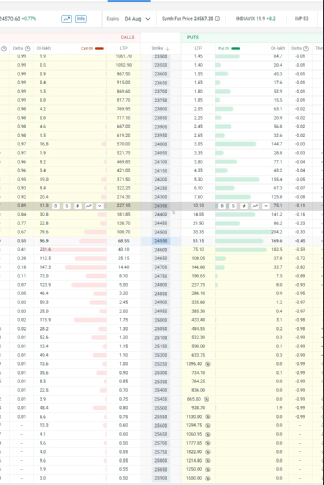
On this chain, the 24,400 strike Call is the strike a buyer should be looking at for a bullish view — its delta places it in the 0.65-0.70 working range, not the far OTM strikes that look cheaper but carry weaker directional tracking. On the Put side, the 24,650 strike is the equivalent read for a bearish view, sitting in the same delta band on the Put side. Notice how the delta column, not the LTP column, is what actually tells you whether a strike fits the buyer's zone or the seller's zone.
| Option Buyer | Option Seller | |
|---|---|---|
| Call delta range | 0.65 to 0.70 | 0.30 to 0.45 |
| Put delta range | -0.65 to -0.70 | -0.30 to -0.45 |
| Strike position | Near-ITM / just below ATM | Moderately OTM |
| What you're paying / collecting for | Directional tracking | Time decay + lower test probability |
| Main risk | Premium erosion if view is wrong | Delta shifting fast on a gap/event move |
| Where hedging fits | Optional, view-dependent | Essential — covered in the Mentorship Program |
Selecting the right delta for entry is only half the picture. A sold option at 0.35 delta today can behave completely differently after a sharp move, and that's exactly where an unhedged position turns into an undefined-risk position. Structuring the hedge — which leg to buy, how far OTM, how it changes your margin and payoff — depends on the specific strategy, account size, and market condition, which is why this part is taught hands-on in the Trading Direction Mentorship Program rather than as a one-line rule in a blog post.
A cheap premium is not automatically a good buy, and a fat premium is not automatically a safe sell. Don't confuse the price tag with the delta. The single most expensive habit I see is traders picking strikes purely on how the premium looks on the screen, then being surprised when a correct market view still produces a flat or losing trade.
For option buying, a delta between 0.65 and 0.70 gives strong directional tracking without paying deep-ITM prices, making it the practical working range for most directional trades.
For option selling, a delta between 0.30 and 0.45 balances a meaningful premium against a lower probability of the strike being tested before expiry.
Delta shows how much an option's price is expected to move for every ₹1 move in the underlying, and it also serves as a rough estimate of the probability that the option expires In-The-Money.
Delta first, premium second. Premium alone doesn't tell you how the option will actually behave as the underlying moves; delta does.
Not by default. Delta can shift quickly on a sharp move or gap, so an unhedged short position carries undefined risk regardless of how safe the entry delta looked.
Hedging structure — which leg to buy, how far OTM, and how it changes margin and payoff — is covered in detail in the Trading Direction Mentorship Program.
Strike selection by delta is simple once you stop reading the premium column first. As a buyer, work the 0.65-0.70 zone for real directional tracking. As a seller, work the 0.30-0.45 zone for decay and probability — and treat hedging as a separate, essential skill rather than an afterthought.
Want to learn how to structure hedges around these delta zones with live examples? Join the Trading Direction Mentorship Program, or watch the breakdown on the Trading Direction YouTube channel.
Explore Courses Read More on the BlogFor a structured, CPR-based approach to entries alongside this delta framework, see the Trading Direction book and trader testimonials.