Free Narrow CPR Stock Scanner: Daily Shortlist for Breakout Trades
Narrow CPR · Stock Scanner
There are no items in your cart
Add More
Add More
| Item Details | Price | ||
|---|---|---|---|
Why buyers should look 15+ days out with ITM strikes, and sellers should look 0-7 days out with OTM strikes
If you are buying options, pick strikes that are 15 or more days from expiry and lean towards In-The-Money (ITM) strikes, since these carry more intrinsic value and give the trade more time to work before theta decay speeds up. If you are selling options, pick strikes that are 0 to 7 days from expiry and lean towards Out-of-The-Money (OTM) strikes, since almost all of that premium is time value, and time value decays fastest in the final week before expiry.
An option's price has two parts — intrinsic value (the real, in-the-money portion) and extrinsic value (the time and volatility premium). Strike selection decides how much intrinsic value you start with; expiry selection decides how fast the extrinsic portion decays.
A trader messaged me last week with a NIFTY 24,500 CE bought two days before expiry. NIFTY had actually moved up 80 points that session. The option still lost money. That single message explains why strike and expiry selection matters more than most beginners realise — the direction call was right, and the trade still failed, because the option was almost pure time value and that time value evaporated faster than the underlying could move.
Yahan problem direction ki nahi, expiry aur strike selection ki hai — the problem here isn't the market direction, it's how the expiry and strike were chosen. This article breaks down exactly how a buyer and a seller should think about it differently, because the same option chain that works for a seller can quietly work against a buyer.
Every strike sits in one of three positions relative to the current spot price of NIFTY or Bank Nifty:
An option buyer pays a premium and needs the market to move enough, before expiry, to cover that premium. Every day that passes, theta quietly eats a slice of the premium — and theta decay is not linear. It stays relatively gentle in the first two to three weeks and then accelerates sharply in the final week.
Now look at what actually happens to time value on a decay curve. From 30 days to about 10 days, the curve slopes down gradually. From roughly day 7 to day 0, the same curve drops off a cliff. A buyer who enters with 15 or more days left is trading on the gentle part of that curve — the market has room to move before decay becomes the dominant force in the price.
Two traders buy a NIFTY 24,600 CE — one with 18 days left, one with 3 days left, at similar strike distance from spot. NIFTY rallies 100 points over the next two sessions. The 18-day option gains meaningfully because time value hasn't started bleeding hard yet. The 3-day option barely moves, because most of what was priced in was already decaying by the hour.
The most common mistake I see is buyers chasing cheap premium on expiry day or the day before, mistaking a low price for good value. It's often cheap because it's decaying fast, not because it's a bargain.
As a buyer, treat 15+ days to expiry as your default zone unless you're specifically running a short, high-conviction expiry-day scalp with a defined stop-loss and a plan to exit within minutes, not hours.
An ITM strike already has intrinsic value baked in, and its delta is higher — meaning the option's price moves more directly with NIFTY's price. This is where it gets interesting: a deep OTM strike might look attractively cheap, but a large part of what you're buying is optimism about volatility and time, not the market's actual move. An ITM strike lets the underlying's own movement do more of the work, so the trade depends less on volatility expansion and more on you simply being right about direction.
Confirmation, stop-loss, and target still apply exactly as with any trade — an ITM strike doesn't remove the need for a plan, it just makes the option's price behaviour easier to read against the chart.
A seller collects premium and profits as that premium decays towards zero. The same fast-decay zone that hurts a buyer in the final week is exactly what a seller wants to be positioned inside.
Look at the same decay curve from the seller's side. In the 0-7 DTE window, theta accelerates — a big share of the remaining extrinsic value can decay within a handful of sessions. A seller who writes an option here is collecting premium at the point where time is working hardest in their favour.
The setup looks good on paper — sell premium, let theta do the work. The problem starts when sellers hold naked, undefined-risk positions through an event day or a gap-up/gap-down opening. Fast decay cuts both ways: a sharp move against a short option in this same window can hurt just as quickly as decay helps.
Sellers working in the 0-7 DTE window should always define risk with a hedge or a strict stop, size the position for the account, and avoid holding short options through major news or results days without a plan for that specific risk.
An OTM strike has zero intrinsic value — its entire premium is time and volatility. Selling it means everything you've collected is exposed to decay, with no intrinsic cushion working against you. The further OTM, the lower the probability that price reaches that strike before expiry, which is why OTM selling in the 0-7 DTE window is a standard approach for traders running defined-risk strategies rather than a naked, unlimited-risk position.
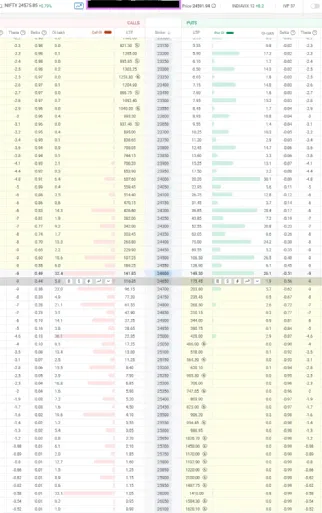
| Option Buyer | Option Seller | |
|---|---|---|
| Preferred DTE | 15+ days | 0-7 days |
| Preferred strike | ITM | OTM |
| Value they rely on | Intrinsic value | Extrinsic (time) value |
| Theta decay | Works against them | Works for them |
| Main risk | Premium erosion if market stays flat | Sharp move / gap against an undefined-risk short |
| Best suited for | Directional swing views with more time | Defined-risk, short-duration premium collection |
A breakout is not automatically a trade — and neither is a cheap option price. The single most expensive habit I see among new option buyers is entering on expiry day because the premium looks affordable, without accounting for how little time value is actually left to work with. Don't confuse a good entry price with a good trade; check the days-to-expiry first, the price second.
As a general rule, 15 or more days to expiry gives an option buyer's premium a meaningful time-value cushion before theta decay accelerates. Shorter expiries suit only specific, high-conviction, short-duration setups with a tight stop-loss.
Time value decays fastest in the final 0-7 days before expiry. A seller collects premium and profits from that decay, so being positioned in this window lets theta work in their favour rather than against them.
ITM, or In-The-Money, means the strike already has intrinsic value — a call strike below the current spot price, or a put strike above it. It's not purely a bet on time and volatility.
ITM strikes are generally easier for a beginner to read, since price behaviour tracks the underlying more directly through a higher delta. Deep OTM options can look cheap but depend heavily on a strong, fast move to become profitable.
This usually happens when the option was close to expiry and mostly extrinsic value. Theta decay can outpace a small favourable move in the underlying, especially in the final week before expiry.
Not automatically. OTM selling has a higher probability of expiring worthless, but if left undefined and unhedged, a sharp move against the position can create losses larger than the premium collected. Risk must always be defined.
Strike and expiry selection isn't a small detail you fill in after picking direction — it decides whether being right about direction is even enough to make money. As a buyer, give the trade time: 15+ days, ITM strike. As a seller, let time work for you: 0-7 days, OTM strike, with risk defined either way.
Want to see this applied live on the NIFTY and Bank Nifty option chain, strike by strike? Check the breakdown on the Trading Direction YouTube channel, or go deeper with the Sunday Live Webinar — CPR Brahmastra Strategy.
Explore Courses Read More on the BlogIf you'd like a structured walkthrough of options with CPR-based entries, the Trading Direction book and trader testimonials cover how students apply this in live markets.