Free Narrow CPR Stock Scanner: Daily Shortlist for Breakout Trades
Narrow CPR · Stock Scanner
There are no items in your cart
Add More
Add More
| Item Details | Price | ||
|---|---|---|---|
TRADING DIRECTION • RISK MANAGEMENT
By Anil Hanegave, Trading Direction | Updated August 2026 | 18 min read
Every trader has lived this moment: you book a ₹2,000 profit, feel relieved, close your laptop — and two hours later the same trade has run another ₹8,000 in your favour without you. You didn't lose money. But you left the biggest part of the trade on the table, and it happens again and again.
This isn't bad luck. It's a predictable pattern rooted in how the human brain handles risk, and it's fixable once you understand three things: how risk-reward actually works, how stop loss and position size are connected, and how to structure an exit so you can hold for the big move without holding your breath.
This guide covers all of it — risk-reward ratio, stop loss placement, position sizing, trailing exits, the psychology of profit booking, and how Trading Direction's CPR and price action framework ties it together.
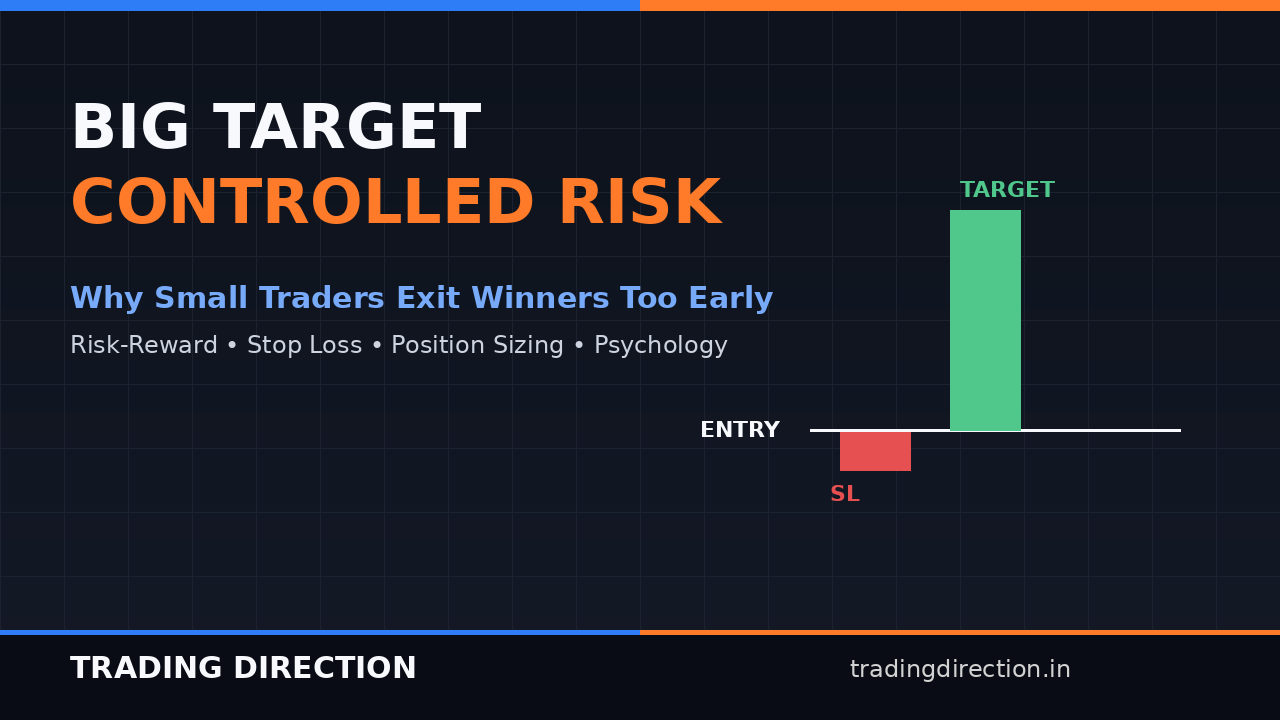
A trade's risk-reward ratio compares the distance from entry to stop loss against the distance from entry to target.
Risk-reward ratio (R:R) compares how much you're risking on a trade to how much you stand to gain. It's calculated as:
Risk-Reward Ratio = (Entry Price − Stop Loss) : (Target Price − Entry Price)
Example: You buy Nifty at 24,500, place your stop loss at 24,450 (risk = 50 points), and set your target at 24,600 (reward = 100 points). Your risk-reward ratio is 50:100, or simplified, 1:2 — for every 1 point risked, you're targeting 2 points in return.
This single number is the backbone of almost every other decision in this guide — your position size, your stop placement, and even how many losing trades in a row you can survive while staying profitable.
Three steps, every time, before you enter:
Divide reward by risk to get your ratio. If risk is 50 points and reward is 150 points, that's a 1:3 ratio. This should be calculated before you enter the trade, not adjusted afterward to make a losing setup look better on paper.
You'll see "always trade at least 1:2" repeated everywhere — and it's a reasonable default. But treating it as an absolute rule misses the real point. What actually matters is your expectancy: the combination of your win rate and your risk-reward ratio, tested over enough trades.
Here's the maths that most traders never actually run:
| Risk-Reward Ratio | Win Rate Needed Just to Break Even |
|---|---|
| 1:1 | 50% |
| 1:2 | 33.3% |
| 1:3 | 25% |
| 1:4 | 20% |
A 1:3 setup gives you more room for error — you can be wrong 3 times out of 4 and still break even. But 1:3 setups usually have a lower win rate in practice, because you're asking price to travel further before you take profit, giving it more chances to reverse first. A high-win-rate 1:1.2 strategy can easily out-earn a low-win-rate 1:4 strategy — it depends entirely on your tested numbers, not the ratio in isolation.
Bottom line: 1:2 is a sensible starting default, not a law of physics. The right ratio for you is whatever your own backtested win rate proves is profitable.
Expected value (EV), also called expectancy, tells you what you actually make per trade on average:
Expectancy = (Win Rate × Average Win) − (Loss Rate × Average Loss)
Can you be profitable with a 40% win rate? Yes — easily, if your average win is big enough relative to your average loss. At a 40% win rate, you need your reward to be at least 1.5× your risk just to break even (0.4 × 1.5 = 0.6 = 0.6 × 1). Push your ratio to 1:2.5 or 1:3 at that same 40% win rate, and you're solidly profitable, even though you're "wrong" 6 times out of 10.
This is exactly why professional traders obsess over risk-reward more than win rate — a strategy that wins only 4 times out of 10 can outperform one that wins 7 times out of 10, purely because of how big the wins are relative to the losses.
This is behavioural, not technical, and it has a name: loss aversion. Research in behavioural finance consistently shows that the pain of losing money is felt roughly twice as strongly as the pleasure of gaining the same amount. So the moment a trade moves into profit, your brain starts treating that "unrealised gain" as something that can be taken away from you — and the urge to lock it in becomes stronger than the logic of your original plan.
At the same time, on losing trades, the brain does the opposite: it delays realising the loss, hoping the trade will "come back," which is exactly why so many traders let losers run far past their stop loss while cutting winners short. This asymmetry — small wins, big losses — is one of the most consistent profit killers in retail trading, and it's known in behavioural finance as the disposition effect.
Ironically, exiting winners too early isn't greed — it's fear dressed up as caution. True greed would mean holding on too long out of wanting more. What actually happens with most small traders is fear: fear of giving back what's already "won." Here's how to manage it practically:
A good stop loss isn't a fixed number of points — it's placed where your trade idea is actually proven wrong. Three reliable methods:
Place your stop just beyond the nearest structural support (for longs) or resistance (for shorts) — not exactly at the level, but a few points beyond it, so ordinary noise doesn't take you out before the level is genuinely broken.
The Average True Range (ATR) measures how much an instrument typically moves in a given period. A common approach is placing your stop at 1–1.5× the ATR away from entry — this automatically adapts to volatility: wider stops in fast-moving conditions, tighter stops in calm ones, instead of using the same fixed point-value regardless of how the market is actually behaving.
Beyond the last swing low/high (for trend trades), beyond the CPR/pivot zone that would invalidate your setup, or beyond a clear volume/order-block area — never at a round number or an obvious level that everyone else is also using, since those are the first places a liquidity sweep will target.
A stop loss that's "too tight" isn't wrong because it's small — it's wrong because it's smaller than the instrument's normal noise. If Bank Nifty is naturally moving 150-200 points intraday on a volatile day, a 30-point stop loss will get taken out by ordinary chop long before your actual trade idea is proven wrong. This is one of the most common ways technically correct trades still lose money.
Match your stop distance to current volatility (via ATR or recent candle ranges), not to a fixed number you're comfortable with emotionally.
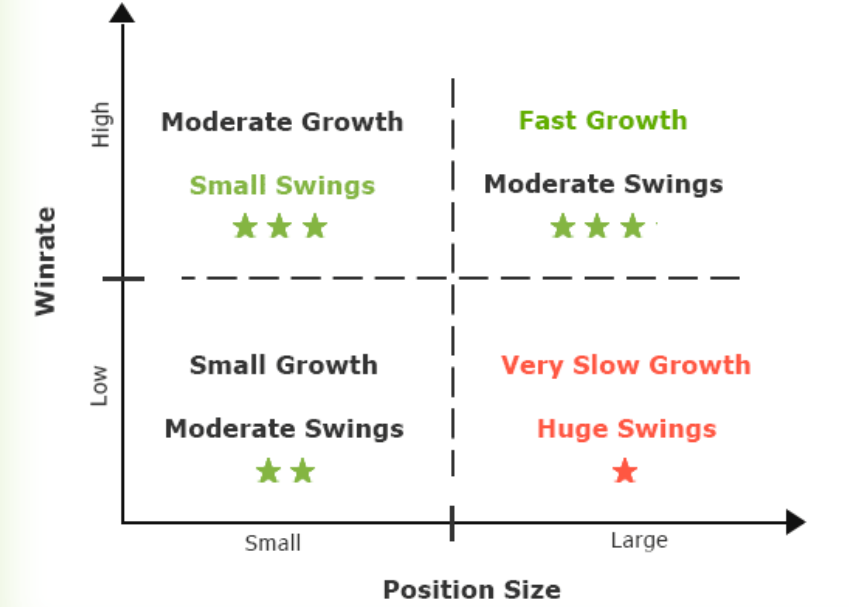
A wider stop with a smaller position size can carry the exact same rupee risk as a tight stop with a larger position size.
This is one of the most misunderstood ideas in trading, and it's worth slowing down for: your rupee risk is not determined by how many points your stop loss is away — it's determined by your position size. A wide stop with a small quantity can risk the exact same amount of money as a tight stop with a large quantity.
Position Size = Rupee Amount You're Willing to Risk ÷ (Entry Price − Stop Loss Price)
Example: Say you're willing to risk ₹1,000 on a trade.
| Stop Distance | Quantity | Total Rupee Risk |
|---|---|---|
| ₹5 (tight) | 200 shares | ₹1,000 |
| ₹20 (wide) | 50 shares | ₹1,000 |
Both trades risk exactly the same ₹1,000 — the only difference is the wider stop gives your trade more room to breathe through normal volatility, while the position size adjustment keeps your risk identical. Traders who avoid wider stops purely because "more points = more risk" are often forcing themselves into stops that are too tight for the instrument's real behaviour, and getting stopped out of otherwise correct trades.
The relationship in one line: stop distance and position size move inversely — as your stop gets wider, your quantity should shrink, and your total risk stays constant. This is the core mechanic that lets you use a big, structurally sound stop loss without ever risking more money than you've decided in advance.
These two ideas get confused constantly, so here's the distinction clearly:
You don't need a big stop loss to get a big target, and a big stop loss doesn't automatically produce a big target either. What connects them is that both require patience and structural logic instead of emotional, moment-to-moment decisions — you decide the levels in advance, size the position correctly, and let the trade play out.
There are two broad ways to exit a winning trade, and each suits a different market condition:
You decide your exit price in advance, based on the next resistance, measured move, or a set risk-reward multiple, and you exit fully there — regardless of what happens after. This works well in range-bound or moderately trending markets where price is unlikely to travel much further.
Instead of a fixed exit, you move your stop loss up (for longs) as price moves in your favour — locking in gains progressively while staying in the trade for as long as the trend continues. This is the method built for capturing genuinely big moves, since it has no fixed ceiling; the trade exits only when the market itself shows the trend is over.
A practical hybrid that many professional traders use: book 30-50% of the position at your first fixed target (satisfying the psychological need to realise some profit), then trail the stop loss on the remaining position to let it run for the bigger move.
Good reasons to move your stop:
The dangerous move: shifting your stop further away from price because the trade has gone against you and you don't want to accept the loss. This isn't risk management — it's turning a planned, sized loss into an unplanned, unsized one. It's the single most common way a small, controlled loss turns into an account-damaging one, and it directly undoes the entire position-sizing discipline described above.
At Trading Direction, our CPR (Central Pivot Range) and price action framework gives you structural levels to plan exits around, instead of guessing:
This is exactly what we teach hands-on inside the CPR Brahmastra Strategy and Intraday Trading Mastery programs — combining CPR, VWAP, and price action so your exits are planned in advance, not decided emotionally mid-trade.
Not every trade deserves to be held for a big target — but certain signs suggest a trend has real follow-through left:
This is "the secret" behind big winning trades — it's rarely a single indicator. It's a combination of structural confirmation, volume, and the discipline to let your pre-planned trailing exit do its job instead of overriding it emotionally.
The mindset shift that separates consistently profitable traders from the rest is simple to state and hard to practice: professionals think in probabilities across a large sample of trades, not in the outcome of any single trade. A professional trader is comfortable being wrong 6 out of 10 times if the maths of their edge is proven — because they know the size of the wins, not the frequency of them, is what ultimately builds the account.
Practically, this means: risk is decided and sized before entry, not adjusted based on how the trade "feels" once it's live; exits follow a pre-planned structure (fixed target, trailing stop, or hybrid) rather than emotion; and every trade — win or loss — is logged and reviewed so the strategy's real, tested expectancy is known rather than guessed.
What is a good risk-reward ratio for intraday trading?
1:1.5 to 1:3 is a common range for intraday trading, but the "best" ratio depends entirely on your strategy's tested win rate. A high-win-rate scalping approach can work profitably even close to 1:1, while a trend-following approach typically needs 1:3 or higher to offset its lower win rate.
How do I calculate position size based on stop loss?
Divide the rupee amount you're willing to risk by the distance (in rupees) between your entry price and your stop loss price. For example, risking ₹1,000 with a ₹10 stop distance gives a position size of 100 shares.
Why do traders let losses run but cut profits short?
This is the disposition effect — a well-documented behavioural bias where the pain of a realised loss feels worse than an unrealised one, so traders delay accepting losses while rushing to lock in gains out of fear of losing them.
Does a wider stop loss mean I'm risking more money?
Not if you adjust your position size. A wider stop with a proportionally smaller quantity can carry identical rupee risk to a tight stop with a larger quantity — the stop distance and position size move inversely to keep risk constant.
How to set stop loss and target in intraday trading?
Set your stop loss beyond a structural level (support/resistance, CPR zone, or ATR-based distance) that would genuinely invalidate your trade idea, and set your target at the next realistic structural level or a tested risk-reward multiple — both decided before you enter, not adjusted mid-trade.
Can you be profitable with a 40% win rate?
Yes. At a 40% win rate, you need an average risk-reward ratio of roughly 1:1.5 or better just to break even — push it to 1:2.5 or 1:3, and a 40% win rate can be comfortably profitable.
What is the best risk-reward ratio: 1:2 or 1:3?
Neither is universally "best." 1:2 typically has a higher win rate and is easier to hit consistently; 1:3 needs price to travel further (often with a lower win rate) but requires fewer winners to stay profitable. The right choice depends on your specific strategy's backtested numbers.
Master risk-reward, CPR-based targets, and disciplined exits inside our CPR Brahmastra Strategy and Intraday Trading Mastery programs.
Disclaimer: This content is for educational purposes only and does not constitute investment or trading advice. Trading in equity and derivatives markets carries substantial risk, including the risk of loss beyond your invested capital, and is not suitable for all investors. Past performance and hypothetical examples are not indicative of future results. Trading Direction is an educational academy and is not a SEBI-registered investment advisor. Please consult a registered financial advisor before making trading decisions.