Narrow CPR Scanner Free Tool — Daily & Weekly NSE Bhavcopy Scanner
Narrow CPR · Stock Scanner
Read article →
There are no items in your cart
Add More
Add More
| Item Details | Price | ||
|---|---|---|---|
The exact CPR levels, entry and BTST carry behind a verified NIFTY Put trade — plus what SEBI's new Closing Auction Session changes for anyone holding an option overnight.
Learn the CPR Brahmastra Strategy
Most BTST write-ups stop at theory. This one doesn't — it's a single NIFTY weekly Put, entered on a CPR Brahmastra setup, carried overnight as a BTST position, and closed for a verified ₹12,080.25 profit. Every level, the entry trigger and the exit are shown on the actual charts and the actual Kite position, not a hypothetical.
Buy Today, Sell Tomorrow (आज खरीदो, कल बेचो) simply means you don't square off the same day — you hold a position overnight to capture a move a single intraday session doesn't give you time for. Applied to options, that means buying a Call or Put near a confirmed CPR level, holding it if the setup stays intact into the close, and exiting on strength the next session. This trade also happened to fall right after SEBI's new Closing Auction Session (CAS) went live on 3 August 2026 — which changes how that overnight "close" is actually formed, so it's worth a quick look before the case study.
Watch the full walkthrough of this BTST trade on the Trading Direction YouTube channel.
BTST simply means you don't square off the same day. In the cash market, that means buying a stock today and selling before delivery even lands in your demat account. In options, it means buying a CE or PE today near a technical level, holding it if price respects that level into the close, and exiting the next session once the target — or the level itself — is tested.
Buy a stock today, sell it the next day before delivery settles — traders capture a quick overnight move in the share price itself.
EquityBuy a Call or Put today near a CPR level, hold overnight if the setup stays intact, and exit next session once the target or CPR level is tested.
F&OFrom 3 August 2026, SEBI replaced the old VWAP-based closing price with a dedicated Closing Auction Session for F&O-eligible stocks and indices. Instead of the closing price being an average of the last 30 minutes of trading, it's now set through a short, transparent order-matching auction window at the end of the day.
For a BTST trader, this matters more than it sounds. The "close" is exactly the price your entire overnight decision is built on — whether a candle closed above resistance, whether price held a CPR level into the bell. A close that's harder to influence in the last few minutes makes that signal more trustworthy, but it also means exits should now respect the auction window's timing rather than the old last-30-minutes habit.
| Before CAS | After CAS |
|---|---|
| Closing price was the VWAP average of the last 30 minutes | Closing price is set by a dedicated order-matching auction window |
| Large last-minute orders could quietly nudge the close | Final price is transparent and harder to influence in the last minutes |
| BTST entries were planned purely off the candle close | CPR and Brahmastra levels stay reliable — but exits should account for the new auction timing |
Every BTST entry in this strategy is filtered through the same three-step sequence — Weekly CPR, then Daily CPR, then a Price match (WDP). Weekly CPR (साप्ताहिक CPR) sets the broader bias for the week. Daily CPR (दैनिक CPR) — narrow or wide, virgin or already tested — shows the real battle happening that day. Only once price actually closes and confirms at a level does the trade get taken; Open Interest, PCR and Max Pain data are used to back up that read, never to lead it.
Rule we teach in every session: OI, PCR and Max Pain confirm a trade — price action at CPR levels always leads the entry and the stop-loss.
Here's how the sequence played out on the chart, from GIFT Nifty's overnight move into the next session's Nifty spot action.

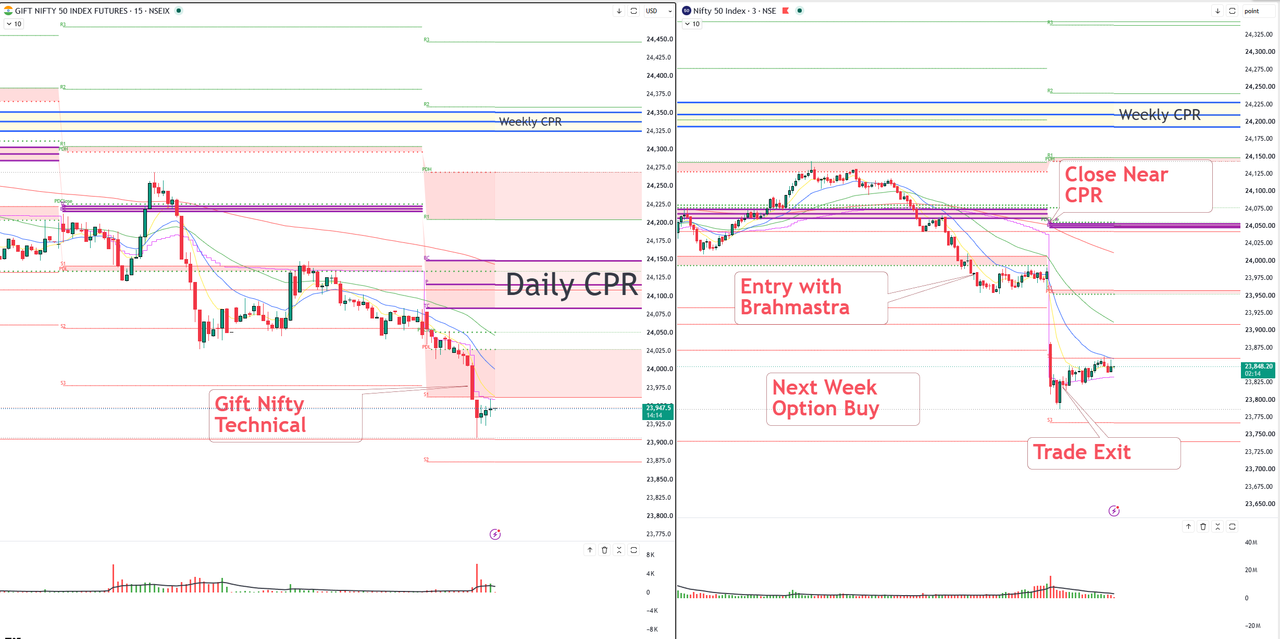
No back-tested hypothetical — this is the actual closed position from the broker terminal.
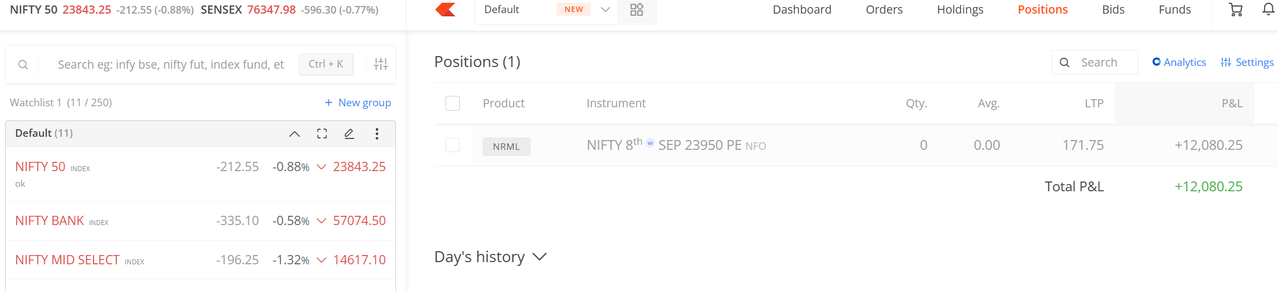
One trade's result. Past performance does not guarantee future outcomes — see the disclaimer below.
BTST stands for Buy Today, Sell Tomorrow (आज खरीदो, कल बेचो) — buying a stock or option today and closing the position in the next trading session instead of the same day.
Yes. Buying (not writing) options and carrying the position overnight is a standard part of F&O trading, subject to your broker's margin and product-type rules for carry-forward positions.
Since 3 August 2026, the closing price for F&O-eligible stocks and indices is set by a dedicated auction window instead of a VWAP average of the last 30 minutes — making the close BTST traders rely on more transparent, but shifting exactly when that close is finalised.
CPR (Central Pivot Range) is a set of pivot-based levels — TC, Pivot, BC, plus R1–R3 and S1–S3 — used to read where price is likely to react. The Brahmastra strategy layers Weekly CPR, Daily CPR and a confirmed price close (the WDP Sequence) before taking a trade.
No. Options can lose their entire premium, and overnight positions carry gap risk. This case study shows one profitable outcome; it isn't a guarantee of similar results on future trades.
The complete framework — Weekly CPR, Daily CPR, Trap Zones and BTST option buying — is taught step by step inside the CPR Brahmastra Strategy webinar at Trading Direction.
Every level and rule used in this trade — Weekly CPR, Daily CPR, Trap Zones and BTST option buying — is taught step by step inside the CPR Brahmastra Strategy webinar.
This article is for educational purposes only and does not constitute investment advice, a trading recommendation, or a solicitation to buy or sell any security. The trade example shown is a real, past outcome and is not a guarantee of similar results in the future — trading in equity and derivatives (F&O) carries a risk of loss, and Nifty options can result in loss of the entire premium paid. Please consult a SEBI-registered investment adviser and assess your own risk appetite before trading. Trading Direction is a market education platform and is not a NISM-certified body — references to NISM concepts are for educational context only.