Free Narrow CPR Stock Scanner: Daily Shortlist for Breakout Trades
Narrow CPR · Stock Scanner
There are no items in your cart
Add More
Add More
| Item Details | Price | ||
|---|---|---|---|
From opening an account to reading a live crude oil price chart and timing your trades on MCX — here's everything you need to start trading crude oil the right way.
Crude oil is one of the most actively traded commodities in the world, and in India, it's also one of the most popular contracts on the MCX (Multi Commodity Exchange). High volatility, global news sensitivity, and near round-the-clock price movement make it attractive — but also risky for traders who jump in without understanding the basics.
This guide answers the question traders search for most: "How can I trade in crude oil?" — covering what crude oil trading actually is, when the market is open, how to read a live chart, why MCX and global (USOIL) prices sometimes disagree, how to pick a broker, and a simple CPR-based approach to get started.
Crude oil trading means buying or selling crude oil futures contracts to profit from price movement, without ever taking physical delivery of the oil. In India, retail traders mostly trade crude oil futures on MCX, where the contract is priced in Indian Rupees (INR) per barrel and tracks the international price of crude (WTI/Brent) adjusted for the USD/INR exchange rate.
Globally, crude oil is also traded as CFDs (Contracts for Difference) on platforms tracking WTI or Brent crude directly in US Dollars — these are the "USOIL" or "UKOIL" symbols you'll see on charting platforms.
One of the most searched questions is "is crude oil trading now?" and "can I trade crude oil 24 hours?" Here's the straight answer for MCX vs. the global market:
| Market | Trading Hours (IST) | 24-Hour Trading? |
|---|---|---|
| MCX Crude Oil Futures | 9:00 AM – 11:30 PM / 11:55 PM (DST-dependent) | No |
| Global Crude (WTI/Brent CFDs) | Sunday evening – Friday night, nearly continuous | Almost (24×5) |
Key takeaway: MCX crude oil is not a 24-hour market. If you only track the global chart overnight and then trade MCX in the morning, you may see gap-ups or gap-downs — factor this into your risk management.
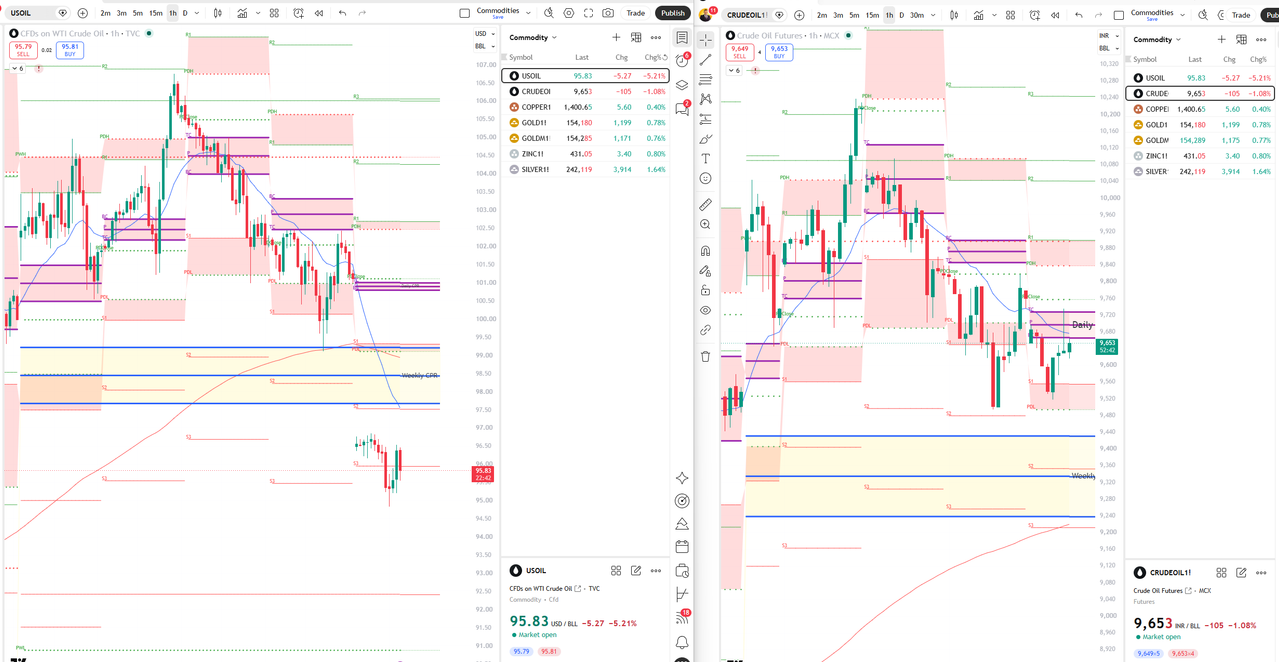
If you track both the global crude oil price (USOIL/WTI CFD) and the MCX Crude Oil futures chart, you'll notice something confusing at times: international crude can fall sharply while MCX barely moves — or one trades below its Weekly CPR while the other trades above it. This isn't a data error. It comes down to four mechanical factors.
USOIL trades 24×5, MCX only 9 AM–11:30 PM. An overnight or weekend crash isn't captured in MCX's weekly range, so its CPR forms lower.
MCX often opens with a gap and then recovers through the session. That gap becomes the weekly low, but the earlier upper structure stays in the range too — so the net % change looks smaller.
MCX price = WTI × USD/INR. If the rupee is weak or flat while dollar crude falls, the INR price won't drop as sharply as the dollar price.
USOIL is a continuous spot CFD. MCX CRUDEOIL1! is a fixed-expiry futures contract with rollover premium/discount, which can distort the H/L/C near expiry.
MCX price trading above its Weekly CPR isn't automatically a bullish signal if it's only there due to session-timing lag. When global crude is weak and MCX looks "artificially" strong, don't chase the rally — look for a setup to fade it at your Daily CPR reject zones instead.
To trade crude oil today, you need a live chart — most traders use TradingView for real-time crude oil price data on both MCX and global feeds. On the chart, focus on:
There's no single "best" broker for everyone — the right choice depends on your trading style and priorities. This isn't financial advice, but here's what to actually compare before choosing:
Open a commodity trading account with a SEBI-registered, MCX-member broker, complete KYC, fund your account for margin, and place buy/sell orders on the MCX Crude Oil futures contract using a defined strategy and stop-loss.
It's buying or selling crude oil futures contracts to profit from price changes, without taking physical delivery of the oil. In India, this is done mainly through MCX.
MCX crude oil trades from 9:00 AM to around 11:30–11:55 PM IST on trading days. Check a live chart or your broker's terminal to confirm the market is currently open, since holiday and DST-linked timing can shift.
Not on MCX — it has fixed daily hours. Global crude oil CFDs (WTI/Brent) trade nearly 24×5 from Sunday evening to Friday night, but that access depends on your broker/platform.
There's no one-size-fits-all answer. Compare SEBI/MCX registration, brokerage cost, margin funding rates, platform stability, and charting tools before deciding what fits your trading style.
Open and fund a commodity trading account, learn the MCX crude oil contract specifications, study a chart-reading method like CPR, and start with small, well-defined positions with a stop-loss.
USOIL trades 24×5, so an overnight or weekend crash is fully captured in its price. MCX only trades 9:00 AM–11:30 PM IST, so that same move gets partly absorbed into a gap-down and recovery, plus the USD/INR rate can cushion the fall when converted to rupees.
Yes. MCX crude oil price is roughly global crude price multiplied by the USD/INR exchange rate. A weaker rupee can offset part of a dollar-crude decline, while a stronger rupee can accelerate an MCX crude oil fall.
NSE-certified trader and mentor, founder of Trading Direction. Author of 9 trading books and creator of the CPR Brahmastra Strategy, teaching 21,000+ students across India.