Free Narrow CPR Stock Scanner: Daily Shortlist for Breakout Trades
Narrow CPR · Stock Scanner
There are no items in your cart
Add More
Add More
| Item Details | Price | ||
|---|---|---|---|
Learn how aligning Weekly CPR with Daily CPR gives you a high-probability options trading trigger — explained with a real Dow Jones (US30) and SGX S&P 500 chart breakdown.
5th August, 6 Min Read.
"Trading a single-timeframe CPR is half a Brahmastra. The full power comes only when Weekly CPR and Daily CPR point the same direction." — Anil Hanegave, Trading Direction
MTF stands for Multi-Timeframe. Every timeframe — Monthly, Weekly, and Daily — has its own Central Pivot Range (CPR): TC, Pivot, and BC. When you read all three together, you know exactly where the bigger participants are comfortable, and where a breakout is likely to trap late entries.
The CPR Brahmastra rule is simple: when price trades above Weekly CPR, and Daily CPR also shows a bullish structure, you get a high-probability setup for call options. as Institutions also Bullish, The mirror logic applies on the downside for put options.
The chart below is my own live TradingView chart on US30 (Dow Jones Industrial Average), 15-minute timeframe, from the 3–5 August session. Price built continuous higher highs across three sessions, trading far above Weekly CPR the entire time.
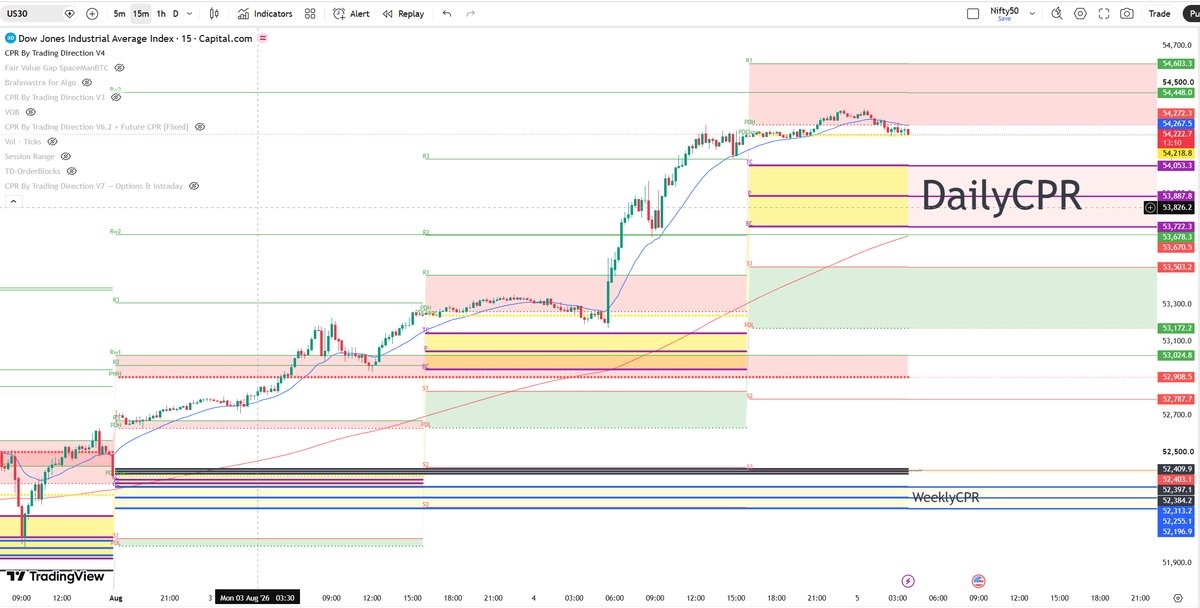
My real chart: US30 (Dow Jones) with CPR By Trading Direction indicator — Weekly CPR near 52,384 supporting a Daily CPR breakout toward R1 near 54,603.
Weekly CPR Pivot was near 52,384 — the base support for the entire week. Daily CPR on the breakout day showed BC near 53,826, Pivot near 53,888, and TC near 54,053. Once price cleared the Daily TC, it ran cleanly into R1 near 54,603.
Because Weekly CPR was sitting thousands of points below current price, the breakout above Daily TC had very low reversal risk. This is exactly the moment when DJI options — flat during the compression phase — start expanding premium fast as the underlying gains momentum.
watch Testimonial from Canada Student,
This second chart is my own screenshot of the S&P 500 Growth index as traded on the Singapore Exchange (SGX), 5-minute timeframe, 30 July to 4 August sessions. Three CPR panels are visible together — Monthly, Weekly, and Daily — and all three were aligned in the same bullish direction.
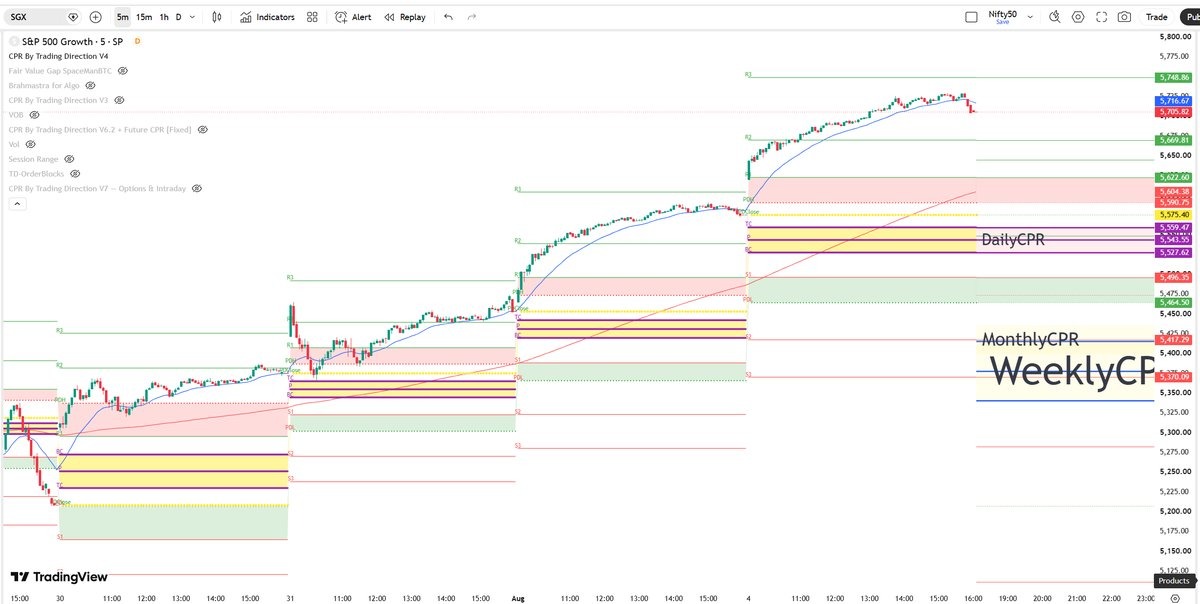
My real chart: SGX S&P 500 with Monthly CPR near 5,417 and Weekly CPR near 5,370, both sitting well below live price — a full Multi-Timeframe Brahmastra alignment.
When Monthly, Weekly, and Daily CPR all lean the same direction, this is the strongest confluence a CPR trader can get. In this SGX example, a Narrow CPR day was followed by a Wide CPR session, and price ran to Daily R2 without a major pullback — the exact signature of a full Brahmastra trigger.
For options traders, this means ITM or near-ATM call premiums expand fastest once all three timeframes confirm the same direction together.
Step 1: Check Weekly CPR Pivot — is price above or below it? This sets your overall bias.
Step 2: Check Monthly CPR — if it matches Weekly, your conviction doubles.
Step 3: Note the Daily CPR type — Narrow (compression) or Wide (trending)?
Step 4: Entry trigger — price clears Daily TC (bullish) or BC (bearish), confirmed with PDH/PDL.
Step 5: Options selection — prefer ATM or one-step ITM strikes; premium expansion is fastest closest to the money on Narrow-to-Wide breakout days.
Step 6: Stop Loss — just beyond PDL for calls, just beyond PDH for puts.
Step 7: Target 1 = Daily R1/S1. Target 2 = Daily R2/S2, only when Weekly CPR also confirms the same direction.
Learn Detail in Smart Trader Program
What is MTF CPR in the CPR Brahmastra strategy?
MTF means Multi-Timeframe — reading Monthly, Weekly, and Daily CPR together. When all three align in the same direction, it is called CPR confluence, the core trigger of the Brahmastra setup.
How does Weekly CPR help in options trading?
Weekly CPR shows the bigger battlefield. If price trades well above Weekly CPR, pullbacks toward Daily CPR support become buying opportunities for call options.
What is a Narrow CPR to Wide CPR breakout?
A Narrow CPR day signals compressed energy. When the next day turns Wide CPR and price breaks the prior range with volume, a trending move usually begins — one of the most reliable Brahmastra triggers.
Can CPR Brahmastra be used on index options like Dow Jones or S&P 500?
Yes. CPR levels work on any liquid index or stock. For index options, CPR gives the underlying's direction, and premium typically expands once Daily R1 or S1 is broken with volume confirmation.

Anil Hanegave
Nationally awarded trading mentor, NSE-certified trader, and founder of Trading Direction, teaching CPR Brahmastra, Smart Money Concepts, and Options Trading to thousands of Indian retail traders.