Narrow CPR Scanner Free Tool — Daily & Weekly NSE Bhavcopy Scanner
Narrow CPR · Stock Scanner
Read article →
There are no items in your cart
Add More
Add More
| Item Details | Price | ||
|---|---|---|---|
A real expiry-day chart, the Option Buyer vs Option Seller truth, and a defined-risk plan you can follow with CPR levels.
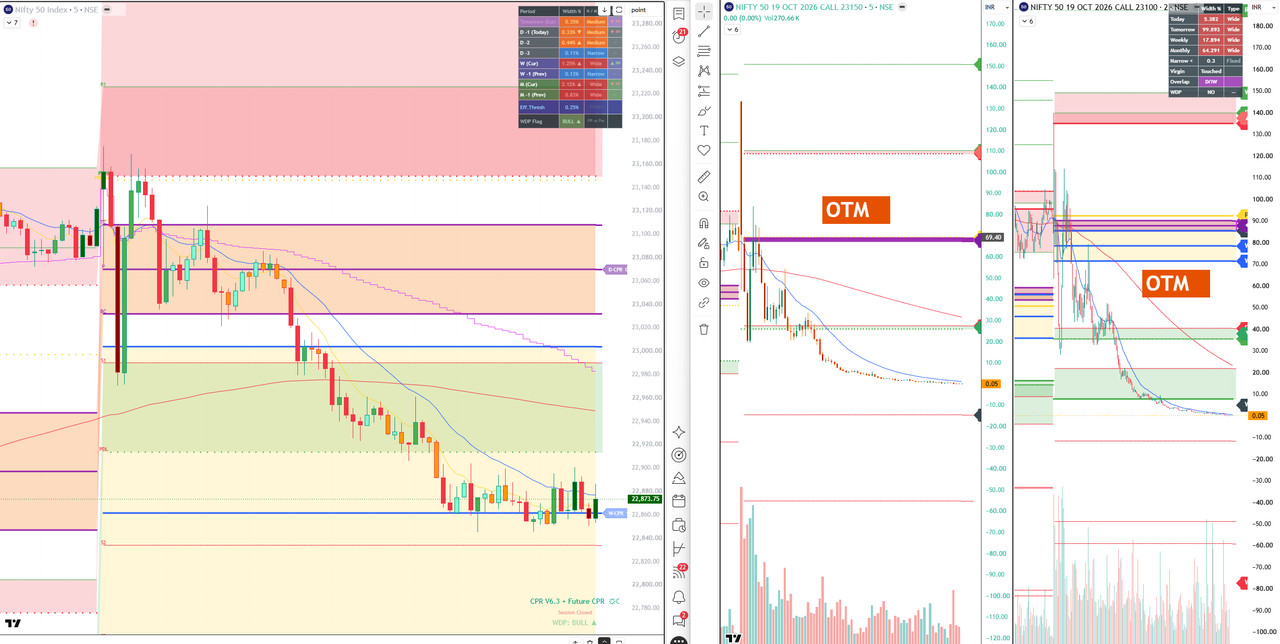
Full expiry-day view: Nifty 5-minute chart with CPR levels (left), 23150 CE (middle) and 23100 CE (right). Tap the image to open it full size.
Options trading on expiry day works only with a plan. Out-of-the-money options lose value fast because of theta decay, so buyers need a strong, quick move. Sellers earn small, frequent gains but carry large tail risk. Use the CPR indicator, trade defined-risk setups, and cap your loss before you enter.
Let me show you something I shared with my students. Look at the chart above. Nifty opened near 23,150, sold off about 270 points and closed near 22,873. The 23150 and 23100 call options, which traded at ₹140 to ₹150 in the opening spike, ended at ₹0.05.
That is a 100% loss for every buyer who held. Many traders said, “So never buy OTM, just sell it.” But one day is not a rule. Had Nifty rallied 300 points instead, those same calls would have exploded and sellers would have been in deep trouble.
Expiry day is Intraday Trading (1 din ka trade) in its purest form. Retail traders love it because premiums are cheap. That is exactly why they struggle: cheap options are cheap for a reason.
This is the most important part of the chart. Look at the indicator panel on the Nifty chart. The current weekly CPR width is 1.25% and the monthly width is 2.12%. Both are marked Wide. When the weekly CPR is this wide and price trades inside it, I call it a Trap Zone.
A wide range lets price swing both ways without a real trend. Breakouts fail and premiums keep leaking. A buyer who bought the 23150 CE on the opening spike was buying inside the trap, not at a clean breakout.
Zoom: Nifty 5-minute chart. Price fell through the daily CPR and stalled at the weekly CPR floor. Tap to open full size.
Nifty then failed to hold the daily CPR, slid through the zone and settled near the weekly CPR floor around 22,860. Sellers had the edge, but only those with defined risk survived the opening spike.
Zoom: the 23150 CE and 23100 CE both bleed to ₹0.05. Tap to open full size.
My rule is simple. Inside a wide weekly CPR, I do not buy OTM. I either stay out or use a defined-risk spread. I take a directional option only after price closes outside the zone with an Elephant Candle.
An out-of-the-money option has no intrinsic value. Its whole price is time value, which falls to zero at the closing bell if the strike is not reached. If you buy a 23150 CE at ₹40, Nifty must go above 23,190 just to break even at expiry.
Now the other side. Expiry days sometimes give a sudden Boom, a sharp one-sided move that turns a ₹5 option into ₹60 in minutes. People post the “zero to hero” wins and never the 20 times it failed. I teach my students to treat the Boom as a bonus, never as the plan.
The Option Buyer has limited risk and unlimited reward, but a low win rate. The buyer needs direction and speed together.
The Option Seller has a high win rate, but the reward is capped and the risk is large. One strong trend day can erase many small wins. In the chart above, a seller who entered during the first spike faced a big adverse move before the decay started.
My view after 9+ years: do not be a naked seller or a lottery buyer. Be a planned trader with defined risk.
The CPR indicator is a Leading Indicator. Top Central (TC), Pivot (P) and Bottom Central (BC) come from the previous day’s data, so you know the levels before the market opens.
On expiry day I check width first. Narrow CPR (below about 0.15% of price) hints at a trending day that favours the option buyer. Wide CPR (above about 0.5%) hints at a range-bound day that favours defined-risk selling. A virgin CPR, which price has not touched, adds weight to the level.
The same chart shows why width matters. The weekly CPR was Wide, so I treated the day as a trap, not a trend.
Check the Gift Nifty chart for the gap direction. Mark yesterday’s high and low, the daily CPR and the weekly CPR, and note whether each is narrow or wide.
The first 5 to 15 minutes are the Opening Trade zone, where premiums swing wildly. I wait and watch for an Elephant Candle, a big-bodied candle that breaks a CPR level with strong volume. If price is still inside a wide weekly CPR, I skip the breakout.
I enter only after a 5-minute candle closes above TC (long) or below BC (short), using an ATM or slightly ITM option, never far OTM.
Decide the exit before you click buy. Example per unit; multiply by lot size.
| Trade Plan | Entry | Stop-loss | Target | Reward to Risk Ratio |
|---|---|---|---|---|
| Buy 23150 CE (breakout above TC) | ₹40 | ₹25 (risk ₹15) | ₹75 (reward ₹35) | 1 : 2.3 |
| Skip: far OTM lottery ticket | ₹5 | No plan | “Hope” | Undefined |
I never risk more than 1% to 2% of capital on one trade. On ₹2,00,000, that is ₹2,000 to ₹4,000. If one lot’s stop-loss exceeds that, I skip the trade. I skip any trade below 1:2 Reward to Risk Ratio.
On a wide-CPR day I prefer a credit spread. Sell the 23150 CE at ₹40 and buy the 23250 CE at ₹12. Your credit is ₹28 and your maximum loss is capped at ₹72 per unit. The reward is smaller, but a runaway trend cannot destroy you.
| Factor | Narrow CPR | Wide CPR |
|---|---|---|
| Expected day type | Trending breakout | Range-bound |
| Better side | Option Buyer (ATM/ITM) | Defined-risk Option Seller |
| Entry trigger | Elephant Candle closing beyond TC or BC | Rejection near R1 / S1 or CPR edges |
| Main danger | False breakout in the first 15 minutes | Sudden Boom breaking the range |
| Risk control | Fixed stop-loss, 1:2 minimum | Spread with capped loss |
Mistake 1: Buying far OTM “because it is cheap.” A ₹3 option is cheap because its chance is tiny. Fix: stay near ATM.
Mistake 2: Chasing the first candle. Fix: wait for a confirmed close beyond a CPR level.
Mistake 3: Selling naked without a hedge. Fix: always use spreads or a hard stop.
Mistake 4: Overtrading. Expiry is exciting, and excitement kills discipline. Fix: set a maximum of two trades and a daily loss limit.
It can work if you buy ATM or slightly ITM options after a confirmed breakout with a fixed stop-loss. Far OTM buying is a low-probability bet because time decay is at its highest.
It has a high win rate, but one trend day can wipe out many wins. Defined-risk spreads, sizing and a stop-loss make it safer.
A virgin CPR is a Central Pivot Range that price has not touched during the day. Traders treat it as a likely support or resistance zone next session.
Enter the previous day’s high, low and close. Pivot = (H+L+C)/3, BC = (H+L)/2 and TC = (Pivot − BC) + Pivot. Mark them before the open and check whether the range is narrow or wide.
Neither wins every time. Buyers do better on narrow CPR trend days, and defined-risk sellers on wide CPR range days. Choose by structure, not emotion.
Disclaimer: This article is for educational purposes only and is not investment advice. Anil Hanegave and Trading Direction are not SEBI-registered investment advisers. Options trading involves substantial risk, and you can lose your entire premium. Please consult a SEBI-registered advisor before trading.
#OptionsTradingOnExpiry #ExpiryDayStrategy #CPRTradingStrategy #NiftyOptions #TradingDirection