Free Narrow CPR Stock Scanner: Daily Shortlist for Breakout Trades
Narrow CPR · Stock Scanner
There are no items in your cart
Add More
Add More
| Item Details | Price | ||
|---|---|---|---|
CAS is now live on F&O stocks in Indian Market. Hence, closing price, your square-off window, and my BTST entry logic have all quietly shifted — here's what changed, a rebuilt BTST screener, a live CPR case study, and how AI-driven tools keep you ahead of it.
For years, the closing price of any stock was the Volume Weighted Average Price (VWAP) of the last 30 minutes of trade — 3:00 PM to 3:30 PM. SEBI has now replaced that, but only for stocks that carry Futures & Options (F&O) contracts (Category I). Everything else (Category II) still runs on the old VWAP method.
For Category I stocks, continuous trading now stops at 3:15 PM. What follows is a structured auction — not open trading — that decides the official closing price:
| What | Category I (F&O stocks) | Category II (rest) |
|---|---|---|
| Continuous trading ends | 3:15 PM | 3:30 PM (unchanged) |
| Closing price method | Auction — max matched volume | VWAP, last 30 min (unchanged) |
| GTT / alerts trigger till | 3:15 PM | 3:30 PM |
| MIS intraday auto square-off | ~3:10 PM (broker-adjusted) | 3:25 PM (unchanged) |
| F&O contract trading ends | 3:40 PM | 3:40 PM |
BTST (Buy Today Sell Tomorrow) lives and dies on one thing: the quality of today's close. You're buying strength going into the close, betting the gap-up continues tomorrow morning. CAS changes three things that every BTST trader needs to rebuild into their process:
Here's a live example from NIFTY showing exactly why the CAS close matters for CPR-based traders. Both marked closes on the chart sit above the Weekly CPR band (yellow zone, TC-P-BC) and above the Daily CPR band (purple TC-P-BC) — a classic Trading Direction bullish confluence setup.
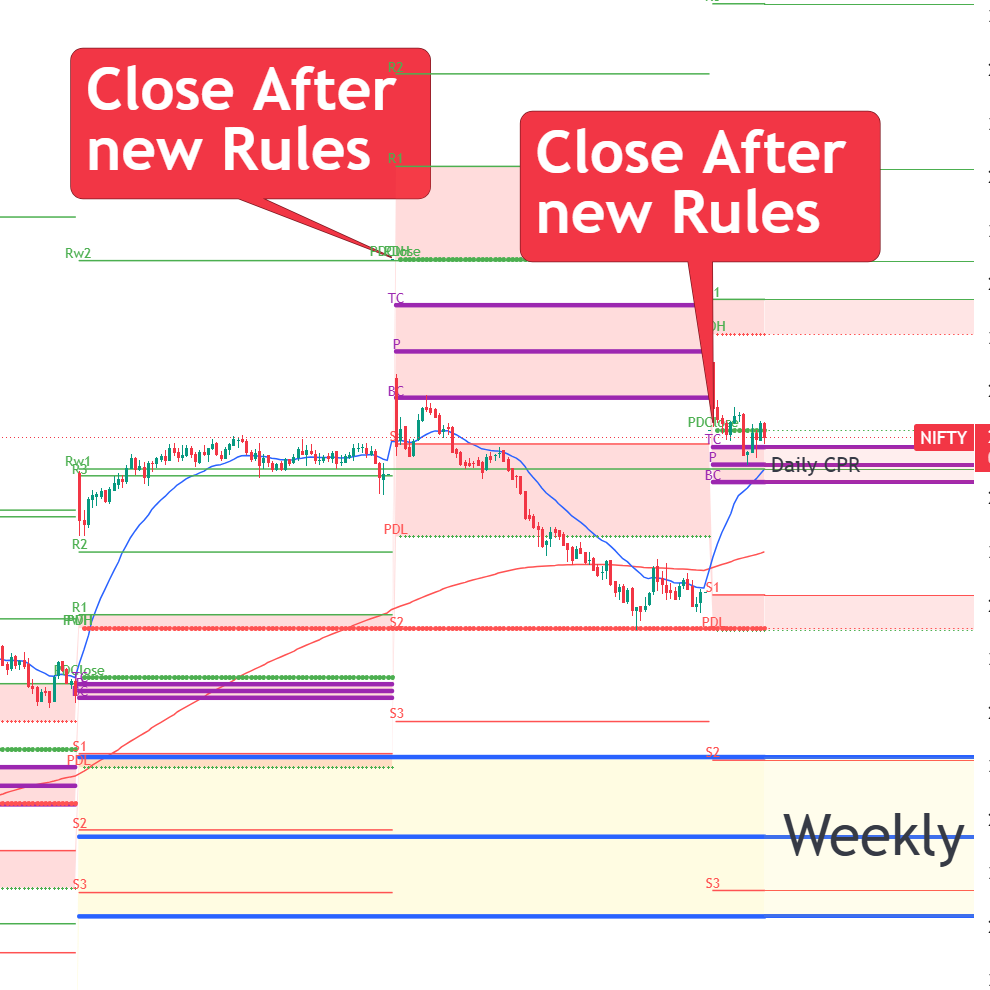
NIFTY — close after the new CAS rules holding above both Weekly CPR (yellow) and Daily CPR (purple). PDH/PDL and R1/R2/S1/S2 zones marked for reference.
The old BTST screener logic — strong close, high volume, near day high — still holds. What changes is when you check it and how tight your entry band needs to be. Here's a Chartink-style scan and the matching TradingView Pine Script alert logic you can adapt.
( {33489} > 500000 and
  close > open and
  close > sma( close, 20 ) and
  ( close - low ) > 0.6 * ( high - low ) and
  close > 0.98 * high and
  ( close - close 1 candle ago ) / close 1 candle ago * 100 > 1.5 )
This checks: strong volume, bullish close above the 20 SMA, close in the top 40% of the day's range, close within 2% of the day's high, and a minimum 1.5% move — a reasonable base filter before you apply your own price action and OI confirmation.
//@version=6
indicator("TD BTST Screener - CAS Aware", overlay=true)

// Time gate: only evaluate strength BEFORE continuous trading halt
inWindow = (hour == 15 and minute <= 15)

strongClose  = close > open and (close - low) > 0.6 * (high - low)
nearHigh     = close > 0.98 * high
aboveSMA     = close > ta.sma(close, 20)
volSpike     = volume > ta.sma(volume, 20) * 1.5

btstSignal = inWindow and strongClose and nearHigh and aboveSMA and volSpike

plotshape(btstSignal, title="BTST Candidate", style=shape.triangleup,
     location=location.belowbar, color=color.green, size=size.small)

alertcondition(btstSignal, title="BTST Setup",
     message="BTST candidate confirmed before CAS cutoff (3:15 PM)")
Note the inWindow gate (samay ki seema) — this is the one line that makes an old BTST script CAS-compliant. Without it, your script keeps evaluating "closing strength" against candles that no longer represent the real close for F&O stocks.
AI-driven trading tools aren't about outsourcing your decisions. Used right, they compress the boring, error-prone parts of strategy work so you spend your time on judgment — reading price action, sizing positions, managing risk — where a trader's edge actually lives.
CAS is SEBI's new auction-based method for deciding a stock's official closing price, effective August 3, 2026. It applies only to Category I stocks — those with active Futures & Options (F&O) contracts. All other stocks (Category II) continue with the old VWAP-based close.
No. Non-F&O (Category II) stocks still close the old way — VWAP of the last 30 minutes, trading until 3:30 PM. Your existing BTST checklist for these stocks stays valid. CAS only affects the ~200+ F&O-enabled names.
For F&O stocks, GTT orders and price alerts now stop triggering at 3:15 PM — the moment continuous trading halts — instead of 3:30 PM. This is a broker-side adjustment to match the new CAS timeline, not a bug.
The exchange collects every buy and sell order placed during the Order Entry sessions and calculates the executable volume at each price level. The price where the maximum number of shares can be matched becomes the official closing price — not an average of trades.
Yes, indirectly. CPR (Central Pivot Range) is calculated from the previous day's high, low, and close. Since the close for F&O stocks is now auction-confirmed rather than VWAP-averaged, the input to your CPR formula is arguably more reliable — which is what the NIFTY case study above illustrates.
AI can translate a clearly defined rule set into working Pine Script or Chartink syntax and speed up backtesting scaffolding. It cannot replace your judgment on position sizing, risk management, or trade execution — every AI-generated script needs to be tested and verified before it touches live capital.
Since continuous trading halts at 3:15 PM for these stocks, brokers have moved the MIS auto square-off earlier — typically around 3:10 PM — to ensure your position exits before the market structure changes. Missing this cutoff can trigger auto square-off charges, so always confirm the exact timing with your broker.
If you want the full CAS-adjusted BTST framework — screener, checklist, and the Pine Script indicator set — along with our Algo & Indicator scripts and the CPR-based Trap Zone tools, everything is on the Trading Direction store.
BTST & STBT strategy course, ready-made TradingView indicator scripts, and stock scanners — all updated for CAS market timings.

Anil Hanegave
Founder, Trading Direction. Author of 9 trading books on CPR, Price Action, Options & Trading Psychology, 9+ years of active NIFTY options trading experience.