Free Narrow CPR Stock Scanner: Daily Shortlist for Breakout Trades
Narrow CPR · Stock Scanner
There are no items in your cart
Add More
Add More
| Item Details | Price | ||
|---|---|---|---|
TRADING DIRECTION • MARKET UPDATE
By Trading Direction | Updated August 2026 | 11 min read
Since August 3, 2026, the last 20 minutes of the Indian equity trading day work differently — and if you trade F&O stocks, use MIS intraday orders, or build your morning levels off CPR (Central Pivot Range), this genuinely changes your routine.
SEBI has replaced the old method of calculating a stock's closing price with a new Closing Auction Session (CAS). This guide breaks down exactly what changed, why SEBI did it, and — because CPR is calculated from the previous day's closing price — how this directly affects the levels you plot every morning.
Previously, a stock's official closing price was simply the average price of all trades between 3:00 PM and 3:30 PM (a 30-minute VWAP-style calculation). From August 3, 2026, SEBI has replaced this with a short, dedicated auction that finds a single "equilibrium" closing price — the price at which the maximum number of shares can actually trade, based on all pending buy and sell orders.
This is the same closing-price mechanism used by major global exchanges, brought in specifically to reduce last-minute price manipulation around the close — something that has been a known concern (SEBI's 2025 action against Jane Street around index-related trading practices was part of the backdrop for tightening this).
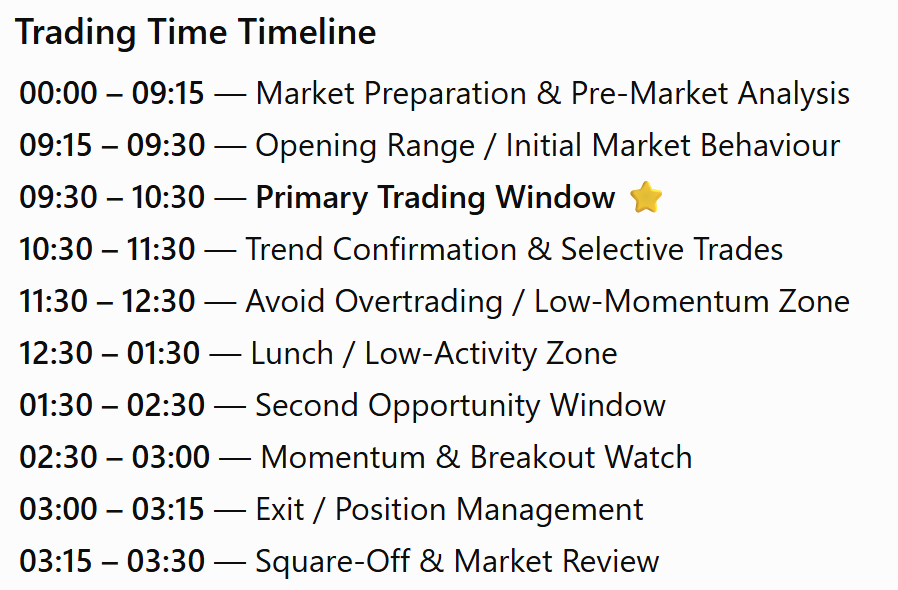
The new end-of-day timeline for F&O eligible stocks, effective August 3, 2026.
Here's exactly how the last hour of the trading day now looks for F&O-eligible stocks (Category I — any stock with active futures & options contracts, including Nifty/Bank Nifty constituents like Reliance, HDFC Bank, ICICI Bank, TCS, Infosys, and hundreds more):
| Time | What Happens |
|---|---|
| Until 3:00 PM | Normal continuous trading, as before |
| 3:00 PM – 3:15 PM | Reference-VWAP window — trades here set the reference price used for the auction |
| 3:15 PM | Continuous trading stops for F&O stocks; the Closing Auction Session (CAS) window opens |
| 3:28 PM – 3:30 PM (randomised) | Order entry window closes at a random second within this range — specifically to prevent last-second manipulation, since no one knows the exact cutoff moment |
| Up to 3:35 PM | Auction matches all orders and determines the single official closing price |
| Until 3:40 PM | F&O derivatives (futures & options) continue trading as normal, unaffected by the cash-market auction |
Non-F&O stocks (Category II — no active derivatives contracts) are unaffected for now and continue on the old 3:00-3:30 PM VWAP method until 3:30 PM, as before. SEBI has left the door open to extending CAS to these stocks in a later phase.
This is the part most intraday traders will feel immediately: since continuous trading for F&O stocks now stops at 3:15 PM instead of 3:30 PM, most brokers have moved their MIS (intraday) auto square-off time earlier — commonly to around 3:05 PM, to leave a safety buffer before the auction window begins.
If you're used to holding intraday positions until 3:15-3:20 PM and squaring off manually, this is a genuine habit to break. Check your specific broker's updated MIS cutoff time — it varies slightly by broker, and getting caught by an earlier auto-square-off than you expected can execute your exit at a worse price than planned.
Delivery holdings, mutual funds, SIPs, and ETFs are completely unaffected — this only changes intraday (MIS) positions and how the closing price itself is calculated.
Central Pivot Range is calculated directly from the previous day's High, Low, and Close. Every level you plot each morning — Pivot, TC, BC, R1-R3, S1-S3 — is downstream of that single Close value. So the question becomes: does the new auction-based closing price change your CPR levels?
In practice, mostly not by much for liquid F&O stocks and Nifty/Bank Nifty constituents — because these names already had tight, well-behaved closing prices under the old 30-minute VWAP method, given how much genuine volume trades in that window. The auction mechanism is designed to converge on essentially the same fair-value price for a liquid stock; it mainly guards against the kind of thin, manipulated closing prints that were more of a risk in less liquid names.
Where it's worth paying closer attention:
The core problem CAS solves: under the old system, the closing price was an average of trades across a fixed 30-minute window — which meant large, coordinated orders placed right at the end of that window could meaningfully influence the "official" close, particularly in options-linked or index-constituent stocks where the closing price feeds into settlement values.
The randomised order-entry cutoff (somewhere between 3:28-3:30 PM, not a fixed second) is the key defence here — no participant can know the exact moment orders stop being accepted, which removes the ability to time a manipulative order for the final seconds. This is the same principle major global exchanges (like the NYSE and NASDAQ) have used in their own closing auctions for years, and SEBI's move brings India's largest, most F&O-active stocks in line with that global standard.
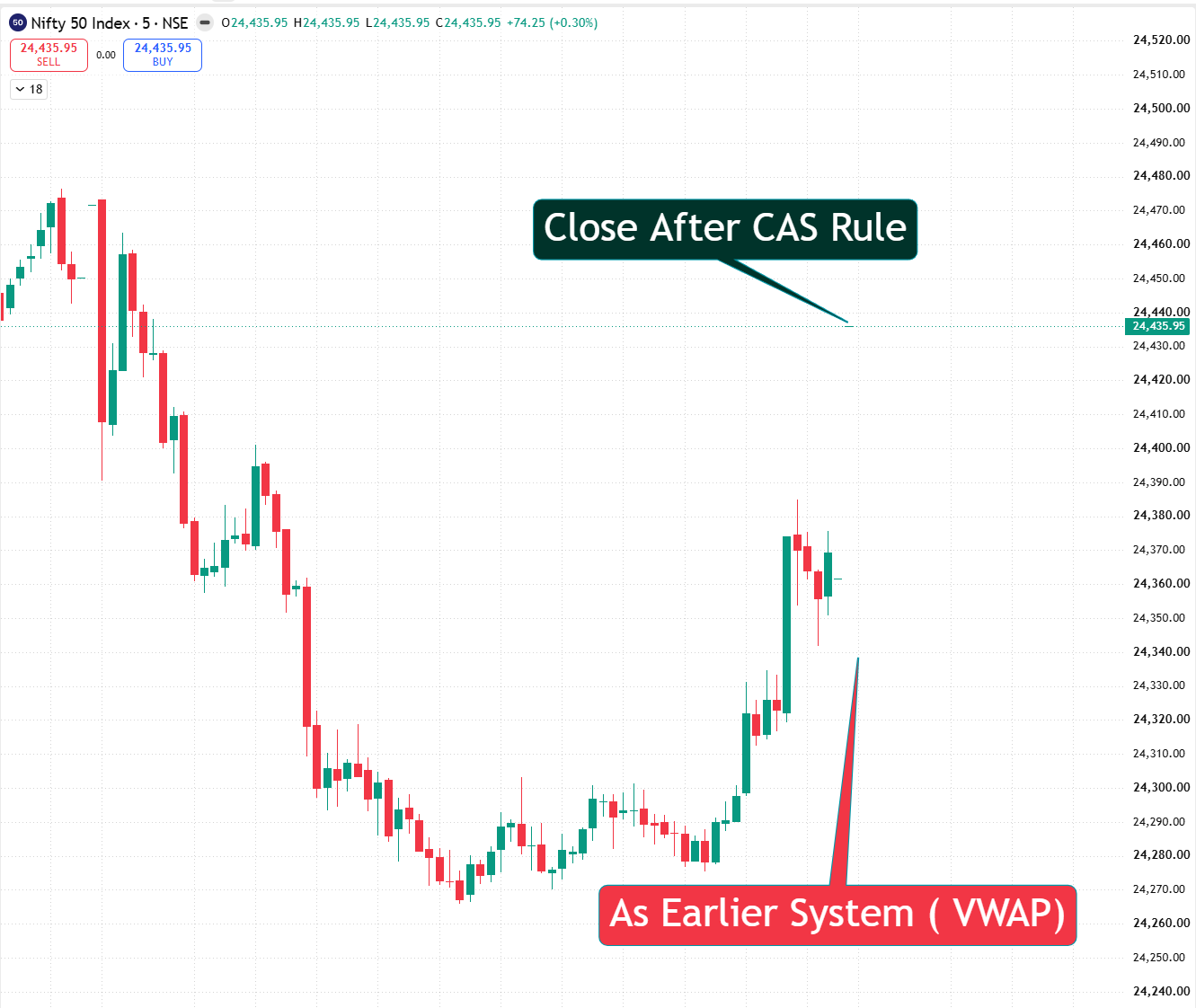
CPR's Pivot, TC, and BC levels all derive from the previous day's Close — now determined by the CAS auction instead of a simple time-window average.
What is SEBI's Closing Auction Session (CAS)?
CAS is a new mechanism, effective August 3, 2026, that determines the official closing price of F&O-eligible stocks through a short auction instead of averaging trade prices over a fixed 30-minute window.
Which stocks does CAS apply to?
CAS applies to Category I stocks — those with active futures and options (F&O) contracts. Non-F&O stocks (Category II) continue with the earlier closing price method for now.
What time does intraday (MIS) trading close now?
Continuous trading for F&O stocks stops at 3:15 PM, and most brokers have moved their MIS auto square-off earlier (commonly around 3:05 PM) as a safety buffer. Check your specific broker's updated cutoff time.
Does CAS affect futures and options trading hours?
No. F&O derivatives continue trading until approximately 3:40 PM as before — only the underlying cash-market stock's closing price calculation changed.
Does the new closing price change CPR levels?
For liquid, actively traded F&O stocks, the impact is generally small since the auction converges close to the same fair-value price the old VWAP method produced. The difference is more likely to show up on high-volatility days like expiry, so it's worth confirming your CPR data source reflects the official CAS-based close.
When does the pre-open auction session change?
From September 7, 2026, under the same SEBI circular, the morning pre-open auction session is also being restructured, though it remains 15 minutes long overall.
Stay ahead of market structure changes with CPR-based strategies that adapt to how the market actually works today — inside our CPR Brahmastra Strategy and Intraday Trading Mastery programs.
Disclaimer: This content is for educational purposes only and does not constitute investment or trading advice. Timings, rules, and phased dates referenced here are based on SEBI Circular HO/47/11/11(3)2025-MRD-POD2/I/2765/2026 dated January 16, 2026, and related exchange notices; please verify current, exact rules and cutoff times directly with your broker and the exchanges before trading, as implementation details can be refined by SEBI/exchanges over time. Trading in equity and derivatives markets carries substantial risk, including the risk of loss beyond your invested capital, and is not suitable for all investors. Trading Direction is an educational academy and is not a SEBI-registered investment advisor. Please consult a registered financial advisor before making trading decisions.