Free Narrow CPR Stock Scanner: Daily Shortlist for Breakout Trades
Narrow CPR · Stock Scanner
There are no items in your cart
Add More
Add More
| Item Details | Price | ||
|---|---|---|---|
Why a ₹9 lakh profit can turn into a ₹1.8 lakh tax bill — and what the 12-month rule really controls in your P&L.
If you sell listed shares within 12 months of buying them, the profit is Short-Term Capital Gain (STCG) and taxed at a flat 20%, with no exemption. If you hold beyond 12 months, it becomes Long-Term Capital Gain (LTCG), taxed at 12.5% — but only on the portion of your gain above ₹1.25 lakh in that financial year. These rates apply to delivery-based cash market trades: positional trading and investing, not intraday.
Capital Gains Tax on stocks is the tax charged on the profit made from selling listed shares, calculated as sale price minus purchase price, with the rate and exemption decided entirely by how long the shares were held before selling.
Most traders find out how capital gains tax actually works only after they've already booked the profit — at which point the holding period is fixed and there's nothing left to plan. That's backwards. The 12-month line between STCG and LTCG should be a decision you make before you enter a position, not a surprise you discover in your ITR.
Before the tax math, a quick refresher on how a positional trade should actually be structured — since the holding-period decisions in this article only matter if the trade itself is sound.
"Positional trading sunne mein simple lagta hai — stock kharido, hold karo, profit lo. Lekin 9 saal ke experience mein maine dekha hai, yahi sabse zyada retail traders ko nuksaan deta hai — sahi entry ke baad bhi."
"Positional trade ka matlab hai — aap kuch hafton se lekar mahino tak stock hold karte ho, intraday ki tarah nahi, lekin sirf 'buy and forget' bhi nahi. Entry ke baad bhi position ko manage karna padta hai."
"Teen cheezein fix karo trade lene se pehle: Entry confirmation — CPR ya price action se. Stop loss — technical trap-zone ke bahar. Aur exit plan — target ya trailing SL, dono decide karke rakho, trade lene se pehle."
"Sabse common mistake — log entry pe toh discipline rakhte hain, lekin exit pe emotional ho jaate hain. Stock 15% chal jaye toh greed aa jaata hai, thoda pullback aaye toh fear. Plan already bana tha — usi pe stick karo."
"Positional trading ka complete risk-first framework seekhna hai? Sunday CPR Brahmastra webinar join karo — link bio mein."
For listed equity shares and equity mutual funds where Securities Transaction Tax (STT) has been paid — which covers almost every retail trade on NSE or BSE — the rule is purely about holding period, not about why you bought the stock.
It doesn't matter whether you called it a "positional trade," a "swing trade," or a "long-term investment" in your own head. The Income Tax Department only looks at two dates: the buy date and the sell date.
Here's where it gets interesting for anyone running a positional strategy in the cash market. You might hold a stock for 8-9 months based on a CPR breakout that kept sustaining, fully intending to ride the trend. If you exit at month 10 because the setup breaks down, that gain is still STCG at 20% — even though it was never an intraday scalp.
This is where many traders make the mistake of treating "not intraday" and "long-term" as the same thing. They aren't. A positional trade closed in month 11 pays the same rate as one closed in week 2.
Since Budget 2024 (effective 23 July 2024), the numbers traders need to know cold are:
Before that, the rates were 15% (STCG) and 10% (LTCG) with a ₹1 lakh exemption — so the gap traders are feeling now is real, not just perception.
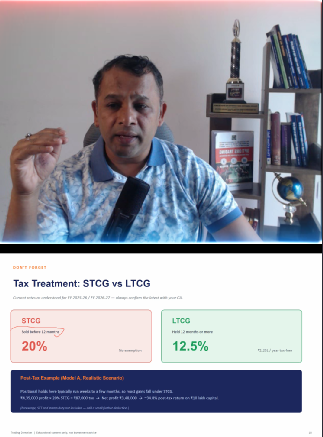
Held ≤ 12 months. Flat rate on the full gain. No exemption threshold. Section 111A.
Held > 12 months. Tax only on gains above ₹1.25 lakh/year. Section 112A.
| Point | STCG | LTCG |
|---|---|---|
| Holding period | ≤ 12 months | > 12 months |
| Tax rate | 20% | 12.5% |
| Annual exemption | None | ₹1.25 lakh |
| Indexation benefit | Not applicable | Not applicable (removed from Jul 2024) |
| Set-off against losses | STCL and LTCL both | Only LTCL |
| Applicable section | 111A | 112A |
A relative of mine sold his positional holdings last year with a clean ₹9,00,000 profit — a genuinely good year by most standards. Because the trades were closed within 12 months, the entire gain was taxed as STCG at 20%.
Profit booked: ₹9,00,000
Tax rate applicable (STCG, no exemption): 20%
Tax paid: ₹1,80,000 (plus applicable cess)
Net in hand after tax: ₹7,20,000
Now run the same ₹9 lakh gain through the LTCG route instead. Only the amount above ₹1.25 lakh is taxable — so ₹7,75,000 gets taxed at 12.5%, which comes to roughly ₹96,875. That's a difference of over ₹83,000 on the exact same profit, purely because of when the position was closed. The setup didn't change. The outcome on paper didn't change. Only the calendar did.
Traders often ask if cash market trading, positional trading, and long-term investing are taxed differently. They aren't — they all fall under the same STCG/LTCG framework for delivery-based equity. What actually differs is the trader's relationship with the 12-month line:
Most cash market trades in the 2-9 month range end up as STCG almost by default, because the strategy is built around momentum and CPR-based entries/exits rather than holding through cycles.
This is the grey zone. A position that was meant to run for 3-4 months but keeps working can either be booked early (STCG) or consciously extended past 12 months to convert into LTCG — a decision worth making deliberately near the 10-11 month mark rather than by accident.
Genuine multi-year holdings naturally land in LTCG territory and benefit from both the lower rate and the annual exemption, assuming the position isn't disturbed.
This comes up often in trader communities, especially after a year like the one above — a ₹9 lakh profit losing ₹1.8 lakh to tax feels heavy, and it's a fair thing to feel. The argument some traders and commentators make is that retail participants, unlike institutions, are trading with post-tax savings, already pay STT on every transaction, and take on real capital risk without the cushioning that funds or FIIs have — so a higher exemption threshold or a lower STCG rate for genuinely retail-sized accounts would encourage more disciplined, longer-holding participation instead of penalising it.
The counter-view, which is also worth knowing, is that STCG and LTCG rates apply uniformly by design — carving out a separate, lower rate for "retail" traders would need a workable definition of retail (by account size, turnover, or income) that doesn't create new loopholes, and capital gains tax remains a meaningful and relatively easy-to-collect source of government revenue, especially as retail participation in Indian markets has grown sharply. Both views get raised whenever Budget season approaches, and it's genuinely an open policy question rather than a settled one — worth watching each Union Budget rather than assuming either direction.
Short-term capital gains on listed equity shares sold within 12 months are taxed at a flat 20% under Section 111A, provided STT was paid on the trade. There is no exemption threshold — the full gain is taxable.
Long-term capital gains on shares held for more than 12 months are taxed at 12.5% under Section 112A, on gains above ₹1.25 lakh in a financial year. Gains up to ₹1.25 lakh are exempt.
Purely by holding period, not intent. A positional trade in the cash market closed within 12 months is STCG at 20%. Held beyond 12 months, it becomes LTCG at 12.5% above ₹1.25 lakh.
Yes — by holding past 12 months where the setup allows, using the ₹1.25 lakh LTCG exemption every financial year, and offsetting gains with realised capital losses.
No. Intraday equity trading is speculative business income, taxed at your slab rate — not the flat 20% STCG rate that applies to delivery-based positional and investment trades.
The government keeps STCG rates higher to encourage longer holding periods over rapid churn. This gap widened further after Budget 2024, when STCG rose from 15% to 20% and LTCG from 10% to 12.5%.
The setup tells you when to enter. Risk management tells you what you're willing to lose. And the calendar — specifically, that 12-month line — tells you how much of your profit you actually keep. Before booking a positional trade near the 10-11 month mark, it's worth asking one extra question alongside your usual exit checklist: is this gain about to cross into STCG or LTCG territory, and does the setup justify closing now versus later?
If your process for reading CPR levels, structuring entries, and managing risk on positional trades still needs sharpening, that's exactly what we work through in the Sunday CPR Brahmastra Strategy Live Webinar.
This article is for educational purposes only and does not constitute investment or tax advice. Capital gains tax rates and exemptions are subject to change by the Government of India; consult a qualified Chartered Accountant for advice specific to your financial situation before making tax decisions. Trading and investing in securities markets carries risk of financial loss.