Free Narrow CPR Stock Scanner: Daily Shortlist for Breakout Trades
Narrow CPR · Stock Scanner
There are no items in your cart
Add More
Add More
| Item Details | Price | ||
|---|---|---|---|
Why the most technically perfect CPR setup still fails without discipline — and how NIFTY options traders can fix it.
Strategy (like CPR, WDP Sequence, Price Action) gives you objective rules for where to enter and where to exit a trade. Psychology governs everything that happens in between — whether you actually follow those rules, how much size you take, whether you exit early out of fear or hold too long out of greed, and whether you can execute the same plan on your 50th trade as calmly as your 1st. A trader with a great strategy and weak psychology will still lose money over time. A trader with average strategy and strong psychology will usually survive long enough to get better. Consistent profit in trading only happens where a tested strategy and disciplined psychology overlap.
Every second NIFTY options trader has, at some point, taken a textbook-perfect setup — CPR width was narrow, price action confirmed, risk-reward was 1:3 — and still lost money on it. Not because the strategy was wrong. Because somewhere between the entry and the exit, emotion (bhavna) took over the trade instead of the plan.
This is the single most misunderstood idea in retail trading: people treat strategy and psychology as two separate subjects — one for "technical" traders, one for "mindset" coaches. In reality, they are two halves of one machine. Let's break down exactly what each one controls, and why trading direction (both the platform's philosophy and literally the direction of your trade) depends on getting both right.
Strategy is the objective, rule-based part of trading. It answers three questions before you ever risk a rupee:
Notice something important: strategy is static. It's written down before the market opens. The CPR level doesn't change because you're nervous. The stop-loss doesn't move because you're hoping. Strategy is the map — and a good map (like the WDP Sequence: Weekly CPR → Daily CPR → Price match) genuinely improves your probability of a correct entry and exit.
But a map only works if the person holding it doesn't panic, deviate, or redraw it mid-journey. That's where psychology takes over.
Psychology is everything that happens after the strategy has already told you what to do — and it's almost entirely about behaviour under uncertainty and pressure.
This is why two traders can use the exact same CPR V7 setup on the exact same NIFTY option, at the exact same time, and end the day with completely different results. One followed the plan mechanically. The other let fear, greed, or overconfidence edit the plan in real time. Strategy sirf raasta dikhati hai (strategy only shows the path) — psychology decides if you actually walk it.
Almost every trader falls into one of four combinations. Which one are you honestly in right now?
| Strategy | Psychology | Typical Outcome |
|---|---|---|
| Weak / no plan | Weak / emotional | Fast, painful account blow-up |
| Strong (tested CPR/Price Action edge) | Weak / emotional | "Good strategy, still losing money" — the most common and most frustrating category |
| Weak / no real edge | Strong discipline | Disciplined execution of a bad plan — slow, controlled losses |
| Strong (tested edge) | Strong discipline | Consistent, repeatable profit over time |
This is the pattern that shows up on a GIFT NIFTY / NIFTY 50 chart more often than any strategy flaw ever will. Strategy did its job — CPR structure (calculated using the standard CPR formula: Pivot = (High+Low+Close)/3) gave a genuinely Right Entry near support with a Narrow CPR bias confirming direction. The trade moved in favour exactly as planned.
Then psychology took over the chart:
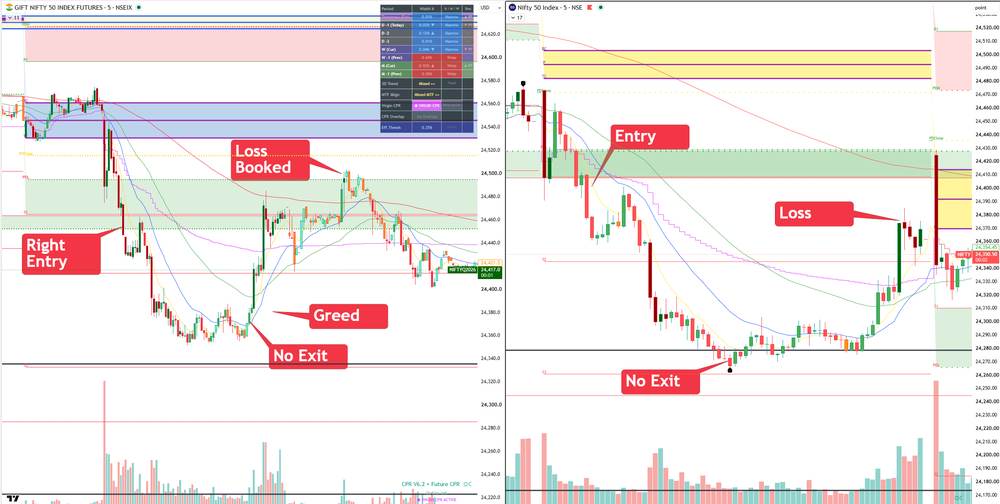
GIFT NIFTY & NIFTY 50 · 5-min · CPR V6.2 + Future CPR — same setup, two different psychology outcomes
Here's the sequence, mapped step by step:
Yeh sabse zyada dard dene wala trading mistake hai — sahi entry lekar bhi loss karna, sirf exit discipline na hone ki wajah se (This is the most painful trading mistake — losing money on a correct entry, purely because of missing exit discipline).
Before you even enter a trade, get the day's structure right using the Free CPR Calculator — plug in yesterday's High, Low and Close and it instantly gives you today's Pivot, TC, BC and all eight support/resistance levels, no manual math required. If you're still calculating CPR levels by hand each morning, the Tomorrow's & Next Week's CPR script goes a step further and auto-plots tomorrow's and next week's CPR levels directly on your TradingView chart, so entry/exit zones are fixed and visible before the candle even forms — removing one more spot where a manual mistake or last-minute "adjustment" could creep in. What happens between the entry candle and the exit candle after that is entirely execution — which is exactly why capital structuring and a written exit rule (covered next) matter as much as the CPR reading itself.
Say your CPR strategy flags a Narrow CPR breakout on NIFTY weekly options — width under 3%, bullish bias confirmed. Strategy has now done its job: it told you the entry zone, the stop-loss level, and a 1:2 target.
What happens next is 100% psychology:
Same setup, same indicator, same CPR reading — four completely different psychological failures, each one turning a statistically sound trade into a loss.
One of the most practical ways to convert psychology from a vague "control your emotions" idea into something mechanical is capital structuring. Before every trade, separate your capital into layers so sizing decisions are made in advance, not in the heat of the moment:
| Capital Layer | What It Means |
|---|---|
| Total Capital | Your entire trading account — never fully at risk on one trade |
| Used Capital | Margin blocked across all open positions right now |
| Engaged Capital | Capital allocated to a specific strategy or setup type |
| Active Capital | Capital genuinely at risk on the live trade in front of you |
When position size is decided by a pre-set framework like this instead of "how confident I feel right now," you remove the exact decision point where greed and fear usually creep in. For a deeper, structured walkthrough of this discipline layer, Anil's book How to Master Trading Psychology covers the full framework chapter by chapter.
A quick reference table to check yourself against before your next trading session:
| Mistake | What It Looks Like | The Fix |
|---|---|---|
| FOMO Entry | Entering before CPR/price action confirms, afraid of missing the move | Wait for the candle close that confirms the setup — no exceptions |
| Revenge Trading | Increasing lot size right after a loss to "recover fast" | Fix position size using your Engaged/Active Capital layer before the session starts |
| Early Profit Booking | Exiting at 1:1 out of fear, even though the plan says 1:2 | Use a partial-booking rule (e.g., 50% at 1:1, trail the rest) instead of an all-or-nothing decision |
| Holding Past Stop-Loss | Hoping price "bounces back" instead of honoring the SL | Place the SL as a hard order at entry — don't leave it as a mental note |
| Greed at Target (No Exit) | Target hit, but holding for "just a bit more" | Pre-write your exit price before entry; treat hitting it as non-negotiable |
No credible data supports an exact percentage split, and treating it as a fixed ratio is misleading. A more accurate framing: strategy determines whether you have a real statistical edge at all; psychology determines whether that edge survives contact with real money and real losses. Without an edge, psychology alone cannot create profit. Without discipline, an edge alone cannot be captured.
The most common reasons are execution errors, not strategy errors: entering before your setup confirms (FOMO), increasing position size after losses (revenge trading), exiting winners early out of fear, or holding losers past your stop-loss out of hope. These are psychology failures layered on top of a working strategy.
No. Discipline only makes an outcome more consistent — it cannot manufacture an edge that doesn't exist. A disciplined trader executing a strategy with no statistical edge will lose money in a controlled, consistent way rather than a chaotic way. Both a tested strategy and disciplined execution are required for actual profitability.
The WDP Sequence (Weekly CPR → Daily CPR → Price match) is a structural framework used to identify high-probability entry and exit zones objectively, before emotion enters the decision. Having a pre-defined structural sequence reduces the number of discretionary, in-the-moment decisions a trader has to make — which is itself a psychology tool, since fewer live decisions mean fewer opportunities for fear or greed to interfere.
Start by pre-defining every trade's entry, stop-loss, target, and position size before market open — not during the trade. Use a capital framework (Total/Used/Engaged/Active Capital) so sizing is never an emotional, in-the-moment decision. Review a trading journal weekly to identify recurring behavioural patterns (early exits, oversizing, revenge trades) separately from strategy performance.
Pivot Point (P) = (Previous High + Previous Low + Previous Close) / 3. Top Central Pivot (TC) = P + (High − Low). Bottom Central Pivot (BC) = P − (High − Low). A narrow gap between TC and BC signals a likely trending/breakout session; a wide gap signals a likely range-bound session. Use the Free CPR Calculator to get today's levels instantly, or the Tomorrow's & Next Week's CPR script to auto-plot them on your TradingView chart.
Yes — a good strategy still matters, but it will underperform its true potential. Think of strategy as the ceiling on how good your results can be, and psychology as how close you actually get to that ceiling. Weak psychology means consistently leaving money on the table (or losing it) even when the underlying edge is sound.
Join the free CPR Brahmastra Strategy webinar and see how the WDP Sequence removes discretionary entry/exit decisions — the exact decisions where psychology usually breaks down.
Reserve Free Webinar Seat 🏹 Explore All Courses & ToolsStrategy and psychology aren't separate subjects to study one after the other — they're two skills to build in parallel. A few direct next steps depending on which side needs work right now:
Browse the rest of the Trading Direction learning library for more strategy and psychology breakdowns like this one.