Free Narrow CPR Stock Scanner: Daily Shortlist for Breakout Trades
Narrow CPR · Stock Scanner
There are no items in your cart
Add More
Add More
| Item Details | Price | ||
|---|---|---|---|
Same strike, same view, same NIFTY level — yet your option loses more value in the last week before expiry than it did in the first three. Here's the Greek responsible for that, and how to trade with it instead of quietly losing to it.
Theta is the amount of an option's premium that decays every single day purely because time is passing, with everything else held constant. It works against option buyers and for option sellers. Theta is not constant — it stays small when there are many days left to expiry and accelerates sharply in the final week, which is why a near-expiry option can lose value fast even on a day the underlying barely moves.
Theta is the Greek that measures the daily decay in an option's extrinsic (time) value — it is the "rent" an option buyer pays and an option seller collects, every day, for the time remaining to expiry.
You buy a NIFTY call three weeks before expiry. NIFTY does nothing for four days — flat, sideways, boring. Your option loses ₹40 anyway. Nobody moved against you. The index didn't fall. Something else took your money, and it wasn't the market — it was theta, working quietly in the background whether you were watching the chart or not.
An option's premium has two parts: intrinsic value (what it's worth if exercised right now) and extrinsic value (everything else — mostly the time left for the trade to work out, plus volatility). Theta is the daily shrink in that extrinsic part. Traders often call it "air" in the premium — it's the value that exists only because there's still time on the clock, and it leaks out a little every day regardless of what NIFTY does.
This is why theta is described as the one Greek every option trader is guaranteed to feel. Delta only moves if price moves. Vega only moves if implied volatility moves. Theta moves every single day, market open or closed, because time itself is the input.
Open any option chain and theta sits right next to delta and vega for each strike, usually shown as a negative number for both calls and puts — negative because it represents value leaving the option. What most beginners skip past is that this number isn't fixed for a strike. It changes as days-to-expiry changes, even if NIFTY and IV stay exactly where they are.
Yahan number chhota lagta hai, lekin lot size aur multiple days multiply karke dekho toh yeh amount bada ban jaata hai — the per-day figure looks small, but multiplied across the lot size and several days, it becomes a real cost that shows up on your P&L whether or not you were tracking it.
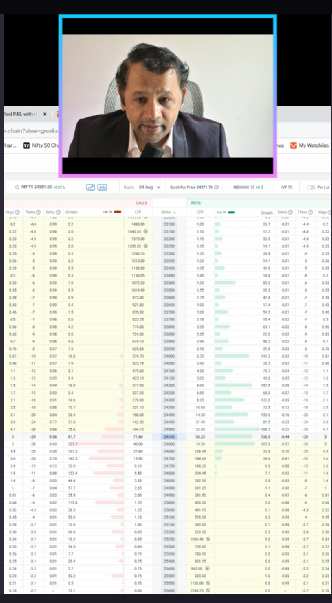
Reading theta in isolation only gets you halfway. In this short, the OI (Open Interest) build-up is read alongside the Greeks on a live chain — the same habit worth building before you check theta on any strike.
Take the same NIFTY ATM contract at two points in its life. With about 22 days left to expiry, theta is doing its job slowly — the option is priced mostly on "there's still plenty of time for this to work," so the daily decay is modest. Now look at the same strike with 8 days left. Theta has picked up noticeably, closer to ₹9 a day on the option. Nothing about NIFTY's level has to change for this to happen — it's purely the calendar moving forward.
This is exactly why two traders can hold what looks like "the same trade" — same strike, same direction view — and have completely different outcomes depending on how many days were left when they entered. The trader who bought with 22 days left has more room for the view to play out before theta becomes the dominant force. The trader who bought with 8 days left needs the move to happen fast, because time is actively working against the position at a much steeper rate.
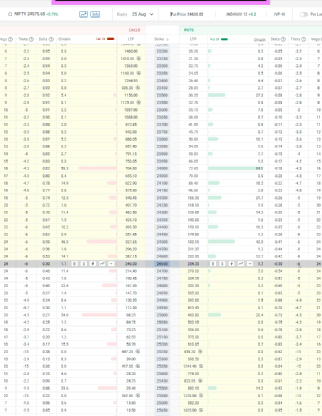
As per theta, the farther expiry is almost always the safer choice for a buyer — not the nearest weekly. Theta is lowest when there's more time left, so a longer-dated option bleeds slower while your view plays out. The worst expiry for a buyer, theta-wise, is the current or nearest weekly inside its last 3–5 days — exactly where decay accelerates hardest.
The trade-off is cost and speed: farther-dated options carry more premium and lower gamma, so they move less per point of NIFTY movement for the same rupee risk. A practical rule most buyers use — the more certain you are that the move happens fast, the closer the expiry can be; the more uncertain the timing, the farther out the expiry should be.
The most common mistake isn't misunderstanding theta conceptually — most traders can define it. It's ignoring it operationally. A beginner sees a weekly option priced cheap close to expiry, likes the "affordable" premium, buys it, and is right about direction the next day — NIFTY actually moves the way they expected. The option still doesn't move up the way they hoped, because theta is eating the gain almost as fast as delta is adding it.
The setup looks good on paper. The problem starts after entry, when the trader realizes being directionally correct isn't the same as being profitable — not when theta on a near-expiry contract is working against every hour that passes without a strong move.
Yahan problem view ki nahi, timing ki hai — the problem usually isn't the market view, it's choosing a contract whose time decay clock doesn't match how fast the trader actually expects the move to happen.
Theta isn't something to avoid — it's something to pick a side of, deliberately, before entering.
Prefer more days to expiry when you're not certain the move will happen within a day or two — it reduces how fast theta works against you while your view plays out. If you're buying with only a few days left, the underlying needs to move meaningfully and quickly, because theta is no longer a background cost — it's a race.
Theta is your ally, and it's strongest in the last week before expiry — this is why many option-selling approaches deliberately target that window. The trade-off is gamma risk rises at the same time theta does close to expiry, so position sizing and stop discipline matter more, not less, in that final stretch.
| Aspect | Far From Expiry (15–30+ days) | Near Expiry (Last week, 5–8 days) |
|---|---|---|
| Theta magnitude | Lower — decay is slow and steady | Higher — decay accelerates sharply |
| Who it favors | Option buyers, directional swing views | Option sellers, especially theta-focused strategies |
| Best use | Views that need time to develop | Fast, high-conviction moves or premium selling |
| Main risk | Premium can still stagnate if IV drops | Gamma risk rises alongside theta — sharp moves hurt sellers fast |
| Position sizing note | Standard sizing, wider time cushion | Tighter risk control, smaller size for buyers |
Theta is the Greek that measures how much an option's premium decreases each day purely due to time passing, assuming price and volatility stay unchanged. It always works against option buyers and in favor of option sellers.
Yes. Theta is calculated on calendar days to expiry, not just trading days, so premium continues to lose time value over weekends and market holidays even though no trading is taking place.
Theta is a cost for option buyers — it reduces the value of a long call or put every day the position is held, regardless of direction. It becomes a bigger problem the closer the contract gets to expiry.
As expiry approaches, there is less remaining time for the option to move in the buyer's favor, so the extrinsic (time) value has to shrink faster to reach zero by expiry day. This is why theta accelerates sharply in the final week rather than decaying at a constant daily rate.
Buying with more days to expiry, avoiding deep out-of-the-money near-expiry contracts, and having a clear time-based exit plan — not just a price-based SL — are the main practical ways buyers manage theta drag.
No. Theta is typically highest for at-the-money options since they carry the most extrinsic value, while deep in-the-money and deep out-of-the-money options generally have lower theta because they have less time value to lose in the first place.
A farther expiry is generally better for a buyer since theta is lower when more days remain. The nearest weekly expiry, especially its last 3–5 days, carries the highest theta and is the riskiest choice unless a fast, sharp move is expected within a day or two.
Theta isn't a warning sign to avoid options — it's a cost or an edge, depending on which side of the trade you're on, and it changes shape as expiry approaches. Before entering any option trade, know the days to expiry, check theta on that exact strike, and decide upfront whether time is working for you or against you. That one habit, repeated every trade, prevents most of the "I was right about direction but still lost money" outcomes beginners run into.
This is exactly the kind of practical, chart-first framework we build in the Pro Trader's Mentorship Program and our other courses at Trading Direction.
Explore the Store →