Free Narrow CPR Stock Scanner: Daily Shortlist for Breakout Trades
Narrow CPR · Stock Scanner
There are no items in your cart
Add More
Add More
| Item Details | Price | ||
|---|---|---|---|
Your entry was fine. What happened after you clicked buy is what decided the outcome.
Managing a trade means controlling what happens after entry — position size, stop-loss discipline, when to exit early, and when to leave a winner alone. Option buyers need to manage this faster than stock traders because theta and volatility work against them every hour the trade stays open. The fix is a fixed pre-trade process plus a small set of rules that don't change based on how you feel in the moment.
Trade management is everything you decide between entry and exit — risk per trade, adjustments, early exits, and when to hold — separate from trade selection, which is about picking the setup itself.
Most traders I work with don't lose money because they can't read a chart. They lose because the moment a trade is open, the process disappears and the emotion takes over. The stop-loss was decided calmly the night before. Then the position moves ₹15 against them at 9:35 AM, and suddenly the stop-loss "needs a bit more room." That single decision, repeated often enough, is the entire difference between a trader who is profitable over a year and one who isn't.
This is true whether you're buying NIFTY options or holding a stock position for a few days. The setups are different. The discipline problem underneath them is the same.
Your rules exist, but nothing enforces them once the trade is live.
Your rules are fixed before entry, so discipline doesn't depend on mood.
Trade selection is picking the setup — a CPR breakout, a support bounce, an earnings-driven stock move. Trade management is everything that happens after you've clicked buy: how much you risk, whether you add or reduce, when you exit early, and when you leave a winning trade alone instead of booking it too soon.
Here's where it gets interesting: a trader can pick the correct direction and still lose money, because the trade wasn't managed. And a trader can pick a mediocre setup and still come out fine, because the risk was controlled from the start. A good setup can still become a bad trade if the process around it is missing.
An options buyer and a stock/futures trader are both managing risk, but the clock works differently for each of them, and the rules should reflect that.
| Factor | Option Buyer | Stock / Futures Trader |
|---|---|---|
| Time pressure | High — theta decay works against you every hour, even if direction is right | Lower — a stock position can sit unmoved for days without cost |
| What kills the trade | Being right on direction but too slow, or wrong on volatility | Being wrong on direction, or holding through a structural breakdown |
| Stop-loss basis | Premium level or underlying level, whichever invalidates the view first | Structure-based — below support, above resistance, below a moving average |
| Position sizing driver | Premium paid, since the whole premium is theoretically at risk | Distance from entry to stop-loss, converted into quantity |
| Most common mistake | Holding a losing option "hoping for a bounce" while theta eats the premium daily | Averaging down into a stock that has broken its structure |
An options buyer who treats a trade like a stock position — "I'll just hold, it'll come back" — is fighting time as well as price. A stock trader who treats every position like an option — closing winners in a day out of nervousness — is giving up the moves that actually pay for the losing trades.
Before you think about the target, know exactly how much you are willing to lose if the setup fails. This decision happens before entry, not during the trade, because a trader under pressure will always negotiate with themselves.
If you want a structured way to build this pre-trade habit specifically for CPR-based setups, Trading Direction's CPR Brahmastra framework walks through exactly this decision sequence before every trade.
Once you're in, your job changes from analysis to execution of the plan you already made. This is where most beginners go wrong — they keep analyzing the chart as if the entry decision is still open, and that reopens every rule they set earlier.
Now look at what this looks like in practice. Say you've bought a NIFTY call on a CPR breakout, stop-loss fixed 20 points below the level. Price moves against you for the first ten minutes — a completely normal thing for a breakout to do while it's being tested. If your stop-loss hasn't been hit, there's nothing new to decide. But this is where the trader who didn't fix a stop-loss level in advance starts negotiating: "let me give it a little more room, it might come back." That's not trade management. That's hope with a chart open in front of it.
A breakout is not automatically a trade. If price comes back inside the CPR range after your entry, your original thesis is already broken, whether or not your stop-loss number has technically been touched yet. The invalidation condition matters as much as the stop-loss price.
On the stock side, the same discipline applies differently. If you're holding a swing position and the stock closes below a support level on volume, that's a structural invalidation — the setup has changed, even if the numeric stop-loss is a few rupees away. Waiting for the exact stop-loss price to be hit while ignoring what the structure is telling you is how a manageable loss turns into a large one.
This side gets ignored more than it should. Booking a winner in ten minutes because you're relieved it's green is the same discipline failure as widening a stop-loss out of hope — it's an emotional decision replacing a planned one. If your plan was to trail the stop-loss to breakeven and then let the structure decide the exit, do that even when the position is up, not just when it's down.
Yahan problem strategy ki nahi, execution ki hai — the problem usually isn't the strategy, it's the execution. The four patterns below account for most of the damage I see in trading journals.
Loss ko recover karne ki jaldi revenge trading mein badal sakti hai — the hurry to recover a loss can turn into revenge trading. A trader takes a loss, then immediately takes a second, lower-quality trade to "get it back" before the session ends. The second trade usually breaks the entry rules that would normally have kept them out of it.
Fix: Decide in advance that after a loss, there's a fixed pause — even five minutes away from the screen — before the next entry is allowed. This one rule alone removes a large share of the worst trades in a typical journal.
Market mein har breakout trade nahi hota — not every breakout in the market is a trade. Overtrading happens when a trader treats every small move as an opportunity, entering and exiting five or six times in a session instead of waiting for the two or three setups that actually match their plan.
Fix: Set a maximum number of trades per session before the market opens. Once you've used them, you're done for the day, regardless of what the chart does afterward.
This is the trade taken because the move has already happened and it "looks obvious" from the outside — chasing a candle that's already three-quarters done. There's no confirmation left to check, because the confirmation already happened without you in the trade.
Fix: If your entry trigger has already passed, the trade is over for you. There will be another setup. There is always another setup.
Adding to a losing position to "improve the average price" without a predefined plan for it is one of the most common ways a manageable loss becomes an account-threatening one — especially for option buyers, where the premium can go to zero.
Fix: Averaging down is only acceptable if it was part of the original plan, with a defined maximum size and a clear invalidation point. If it wasn't planned before entry, it's not a strategy — it's hope with more capital behind it.
If journaling these patterns and catching them early is something you want to build as a habit, Trading Direction's blog covers process and psychology topics like this regularly, alongside the technical strategy content.
Risk management is not a chapter you read once. It's a short, repeatable checklist you run every single session until it stops feeling like a checklist and starts feeling like how you naturally trade.
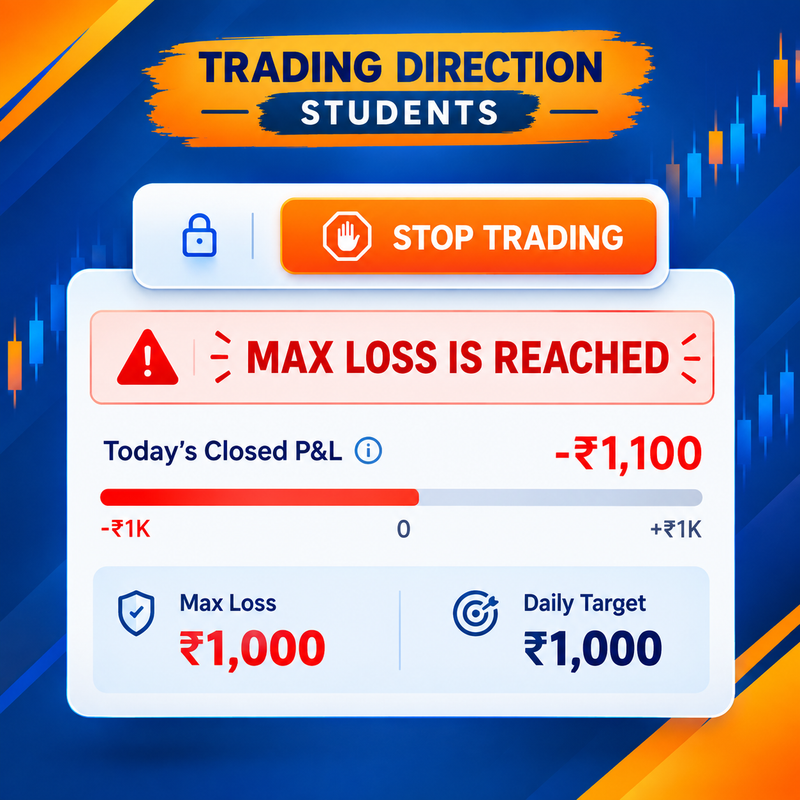
Your "max loss for the day" is only useful if it's a hard stop, not a suggestion. Once the day's closed P&L touches that number, the process is simple: you stop trading, not "trade one more time to recover it." The lock is the point — it removes the decision from a moment when you're least equipped to make it well.
The review step is the one traders skip most often, and it's the one that compounds fastest. A trader who reviews their trades against their own rules for a month usually finds the same one or two mistakes repeating — and once you can see a mistake clearly, it's much harder to keep making it without noticing.
Most disciplined option buyers risk a small, fixed percentage of trading capital per trade — often in the 1-2% range — so that a string of losses doesn't meaningfully damage the account. The exact number matters less than picking one and applying it to every trade without exception.
No. A stop-loss decided calmly before entry reflects your actual risk tolerance and the setup's invalidation point. Widening it mid-trade is usually an emotional decision made under pressure, not a technical one, and it's one of the most common ways a small loss becomes a large one.
Yes. Options carry time decay, so a stalled trade actively loses value even without adverse price movement. Stock and futures positions are exposed mainly to price risk, so they can be held longer without the same daily cost, though margin and overnight risk still apply.
Revenge trading is taking a lower-quality trade immediately after a loss in an attempt to recover it quickly. A fixed pause after every loss — even a short one — before the next entry is allowed is the simplest practical way to interrupt the pattern.
There's no universal number, but setting a fixed maximum before the session starts — and stopping once you've reached it — prevents the low-quality, impulsive trades that tend to show up later in an overtraded session.
This usually points to a management problem rather than an analysis problem — the direction is right, but position sizing, stop-loss discipline, or exit timing isn't. Reviewing your trade journal against your own rules, rather than against the outcome, usually reveals where the gap is.
The setup gets you into a trade. The process decides whether that trade makes money. Fix your risk, size, and invalidation before you enter, follow that plan while the trade is open regardless of how it feels in the moment, and review what actually happened afterward. Do this consistently enough, and it stops being a discipline you have to force — it becomes how you trade by default.
If you want this process taught step by step, with live chart examples and a structured framework rather than piecing it together alone, explore Trading Direction's courses or read what other students have experienced on the testimonials page.
This article is for educational purposes only and does not constitute investment advice. Trading in equities, futures, and options carries financial risk, including the risk of loss of capital. Past performance or hypothetical examples are not indicative of future results. Please consult a SEBI-registered advisor and assess your own risk appetite before trading.