Free Narrow CPR Stock Scanner: Daily Shortlist for Breakout Trades
Narrow CPR · Stock Scanner
There are no items in your cart
Add More
Add More
| Item Details | Price | ||
|---|---|---|---|
By Anil Hanegave, Trading Direction · Updated 7th August 2026 · 14 min read
Intraday Options Trading means buying or selling Call (CE) and Put (PE) options on indices like NIFTY and BANKNIFTY, or on highly liquid derivative stocks such as Reliance, HDFC Bank, and Adani Ports & SEZ. In intraday trading, every position is opened and closed on the same day before the market closes.The biggest advantage of intraday trading is that you don't carry your positions overnight. This protects you from unexpected gap-up or gap-down openings caused by major news events, global developments, or operator-driven volatility. For example, during periods of geopolitical tensions or major political announcements, markets can open with huge overnight gaps, making it difficult to manage risk.By exiting all trades before the closing bell, you stay in control of your risk and avoid unnecessary overnight surprises. That's why many professional traders prefer intraday trading—it lets them focus on market opportunities during trading hours without worrying about what might happen after the market closes.
At Trading Direction, our top mentor Mr. Anil Hanegave, defined every intraday options trade and that goes through three checks before entry:
Read the full mechanics in What is CPR? Complete Guide to Central Pivot Range Trading.
If you're new to CPR, don't start with all six levels (Above CPR - R1, R2, R3, below CPR S1, S2, S3) at once. Begin with three things only:
| Signal | What it means | Beginner action |
|---|---|---|
| Price above TC | Bullish bias for the session | Look for call-buying setups only, as Market is in Bullish phase. |
| Price below BC | Bearish bias for the session | Look for put-buying setups only |
| Narrow CPR (TC−BC < 14 pts on Nifty) | A trending/volatile day is likely | Widen targets, trail with Pivot Point level and VWAP/20 EMA |
The single highest-probability beginner setup is the Virgin CPR reaction — the first time price touches a CPR zone it hasn't traded into yet during the session. See exactly how this plays out in the case study below.
Full walkthrough with chart examples.
The complete framework, step by step.
Small capital doesn't mean small discipline or low confidence — if anything, position sizing matters more. Three rules for accounts under ₹50,000:
The case study below is a real example of this in practice: two option legs, sized and scaled into the same Virgin CPR Resistance setup rather than spread across unrelated trades.
Every rule below is non-negotiable in the Trading Direction framework — they exist specifically to stop a small loss with predefined risk from becoming an account-ending one:
| Rule | Why |
|---|---|
| Stop loss on the opposite boundary of the CPR zone you entered on, Trap Zones. | Gives the trade room to work without giving back the whole thesis |
| Fixed before entry with buffer, never widened after entry. | Widening a stop mid-trade turns a non manageable loss into an account-ending one |
| One re-entry maximum per setup, per intraday session. | Prevents revenge-trading a Virgin CPR zone that's already failed once |
| Hard exit by 3:10 PM regardless of P&L, after new CAS Rules. | No intraday option position carries theta/gap risk overnight |
Dated case study — BANKNIFTY weekly expiry session, 10 Nov 2022.
BankNifty opened the session weak and by mid-morning was trading at 41,374.70, down 407.55 points (−0.98%), approaching a CPR resistance zone that price had not touched yet that session — a Virgin CPR Resistance zone plotted by the CPR By Trading Direction indicator between roughly 41,570 and 41,613. below is my live options trade.
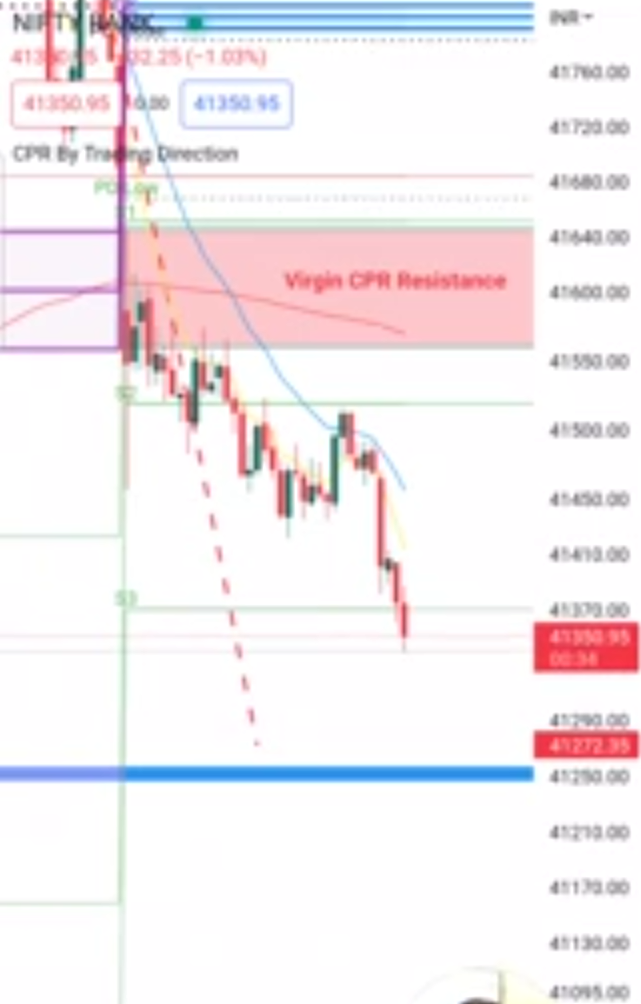
BankNifty testing the Virgin CPR Resistance zone for the first time in the session.
Two rejection candles formed at the edge of that zone rather than a clean break above it — the confirmation signal the framework requires before entry.
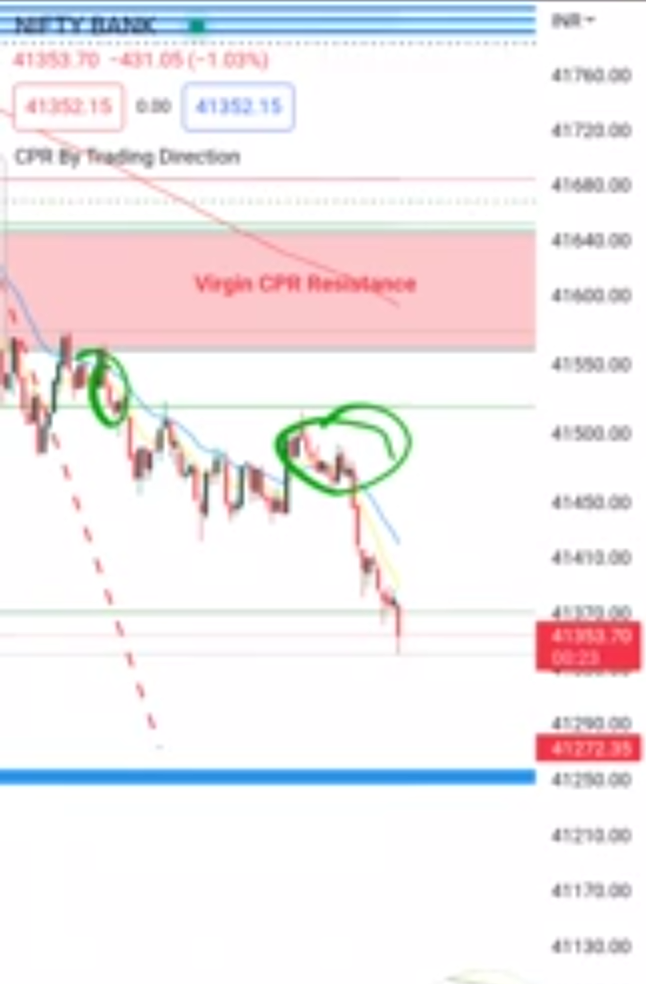
The two confirmation points (circled) where price failed to hold inside the Virgin CPR Resistance zone.
With the rejection confirmed, BANKNIFTY put options were bought across the 41,500, 41,600, and 41,700 strikes (weekly expiry), averaging in at 126.60 and 177.04 respectively. At that point the open positions showed a combined Total P&L of +₹2,706.25.
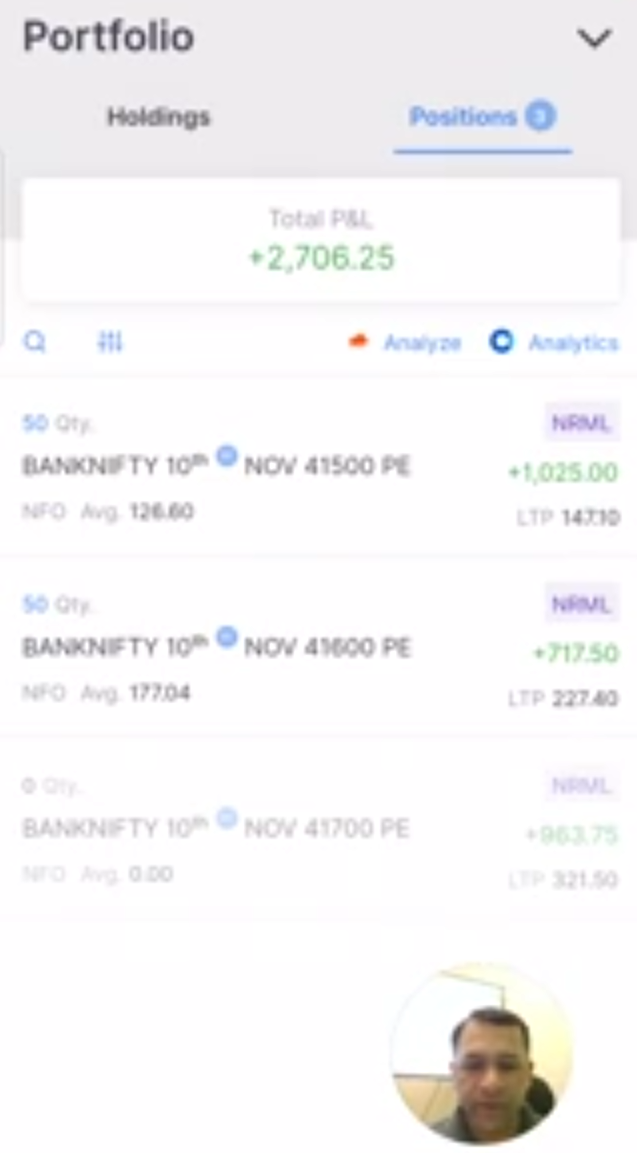
Live positions — 41,500 PE and 41,600 PE open, combined P&L at +₹2,706.25.
Price continued lower and broke down through the CPR range and the S3 support level plotted on the chart, confirming the bearish breakdown thesis for the rest of the session.
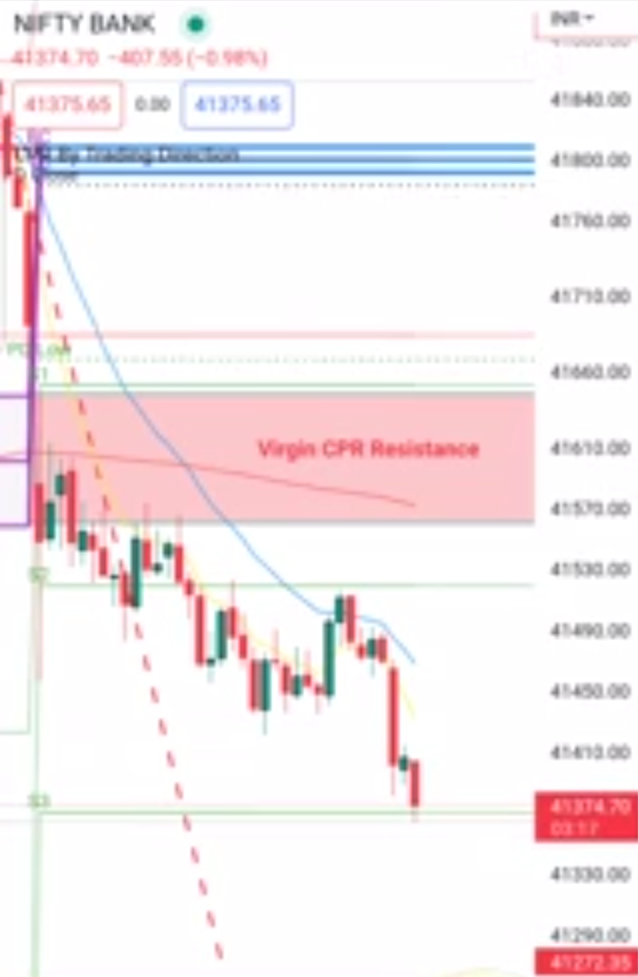
Continuation of the move toward the S3 support level after the Virgin CPR Resistance rejection.
By the time the positions were reviewed again, the combined Total P&L had grown to +₹4,236.25 — the 41,500 PE alone moving from an average of 126.60 to a last traded price of 152.80, and the 41,600 PE from 177.04 to 234.45.
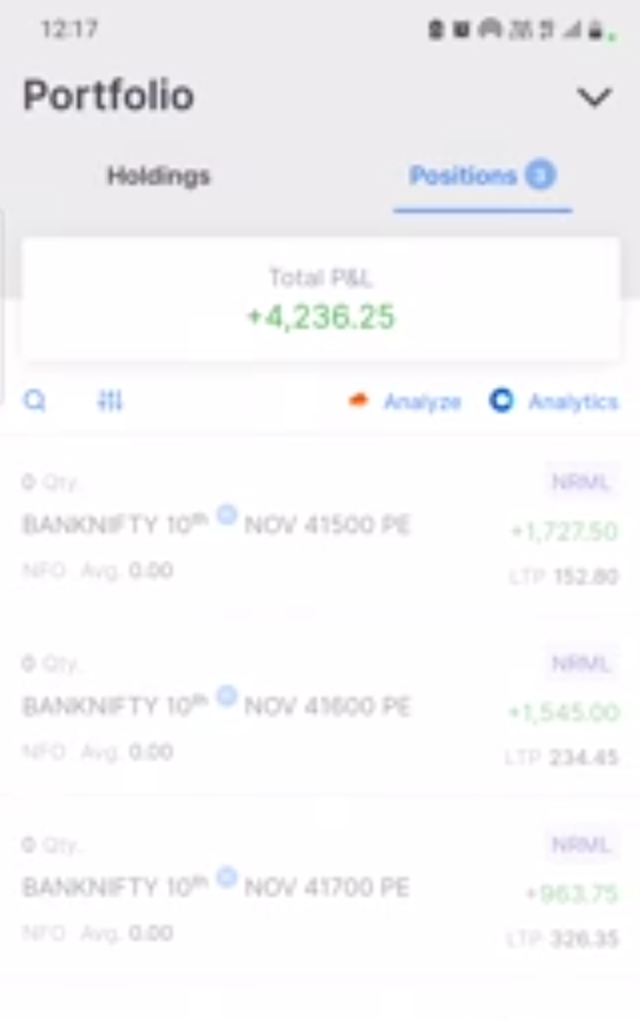
Same positions later in the session — combined P&L up to +₹4,236.25.
Disclaimer: this is a single, real, dated trade shared for educational illustration. It is not a guarantee of future results.
See the CPR framework applied in real time on the Trading Direction YouTube channel:
Short-form live example: watch on YouTube Shorts →
Trading Direction has trained 21,000+ students in the CPR + Price Action + Heikin Ashi methodology through the Intraday Trading Mastery course, CPR Brahmastra Strategy, and Pro Traders Mentorship Program, and is recognised with the Dr. Shyama Prasad Mukherjee Memorial Award and the Maharashtra Udyog Bhushan Award.
I used CPR Trading Strategy by using CPR By Trading Direction V6 and Got excellent results thank you Anil Sir.
— Mr. Mahesh Kumar, Canada, Originally from Surat.
It can be Loss or Profit, my job is to define risk and framework and strict entry and exit with risk rules — most beginner losses come from oversized positions and no stop loss, not from being wrong on direction. Learn Difference between risk and system in Pro Traders Mentorship Program.
You can start with a small account of 10,000, if you size positions by fixed % risk rather than fixed lot size — see section 3 above.
Set your stop on the opposite boundary of the CPR zone you entered on, or on Trap zone for Brahmastra, fix it before entry, and never widen it mid-trade. Full rules in section 4 above.
A CPR resistance zone specially Wide that price has not yet touched during the current session — the first touch tends to produce a strong reaction, as shown in the case study above.
Trading Direction is an educational platform. All content, including the case study on this page, is shared for learning purposes — not as investment advice.
By Anil Hanegave, Trading Direction · Fri Aug 7, 2026 · 8 min read
Part of the Intraday Options Trading: The Complete Guide series.
A stop loss doesn't fail because the level was wrong — it fails because it wasn't fixed before entry, or it was moved once the trade started going against the position. Both are discipline failures, not analysis failures. The four rules below exist to remove that discipline gap entirely, so the stop is a mechanical decision made once, not an emotional one made repeatedly during the trade.
| Rule | Why |
|---|---|
| 1. Stop on the opposite CPR boundary. If you enter a put on a Virgin CPR Resistance rejection, your stop sits above TC of that same zone — not an arbitrary point-value away. | Ties your risk directly to the level that would prove the setup wrong, instead of a guess. |
| 2. Fixed before entry, never widened after. Decide the stop before you place the order. Once the trade is live, the stop only moves in your favour (trailing), never against you. | Widening a stop mid-trade is the single most common way a small, planned loss becomes an account-ending one. |
| 3. One re-entry maximum per setup, per session. If a Virgin CPR zone fails once and stops you out, you get one re-entry on renewed confirmation — not three. | Prevents revenge-trading a level that's already proven itself unreliable that session. |
| 4. Hard exit by 3:15 PM, regardless of P&L. Every intraday option position is closed before the session ends, win or lose. | No position carries theta decay or overnight gap risk it was never meant to hold. |
Say BankNifty rejects a Virgin CPR Resistance zone with TC at 41,613 and BC at 41,570 — the same zone from the live case study in the pillar guide. A put is bought on confirmation of the rejection. The stop loss is placed with the underlying invalidation at a close back above TC (41,613) — not 50 points away, not "wherever feels safe," but at the exact level that would mean the rejection thesis was wrong. That level is fixed before the order goes in, and it does not move for the rest of the trade.
See the full trade play out with real screenshots in the Live Case Study section of the main guide.
| Mistake | Correct Approach |
|---|---|
| Setting a stop based on a fixed rupee amount instead of the invalidation level | Set the stop where the setup itself is proven wrong (opposite CPR boundary), then size your quantity to fit your risk % |
| Widening the stop when the trade "just needs a bit more room" | The stop was placed at the invalidation level for a reason — if it's hit, the thesis was wrong |
| Holding past 3:15 PM hoping for a reversal | Exit on the clock, not on hope — theta and gap risk aren't worth it |
| Re-entering the same failed zone repeatedly | One re-entry maximum per setup, per session |
On the opposite boundary of the CPR zone you entered on — below BC on a long put entered at resistance, or above TC on a long call entered at support.
Set your invalidation level on the underlying index using CPR, then translate that into a premium-based stop for order placement, since index levels are what confirm or invalidate the setup.
No. Widening a stop after entry is one of the most common ways a manageable loss becomes an account-ending one.
By 3:15 PM regardless of open profit or loss, so no position carries theta decay or overnight gap risk.

Anil Hanegave, Amazon Bestselling Author
Founder, Trading Direction — CPR, Price Action & Heikin Ashi trading education for 21,000+ students across India.
← Back to the full Intraday Options Trading Guide
Disclaimer: This page is for educational purposes only and does not constitute investment advice. Trading involves risk — please consult a SEBI-registered advisor before trading.